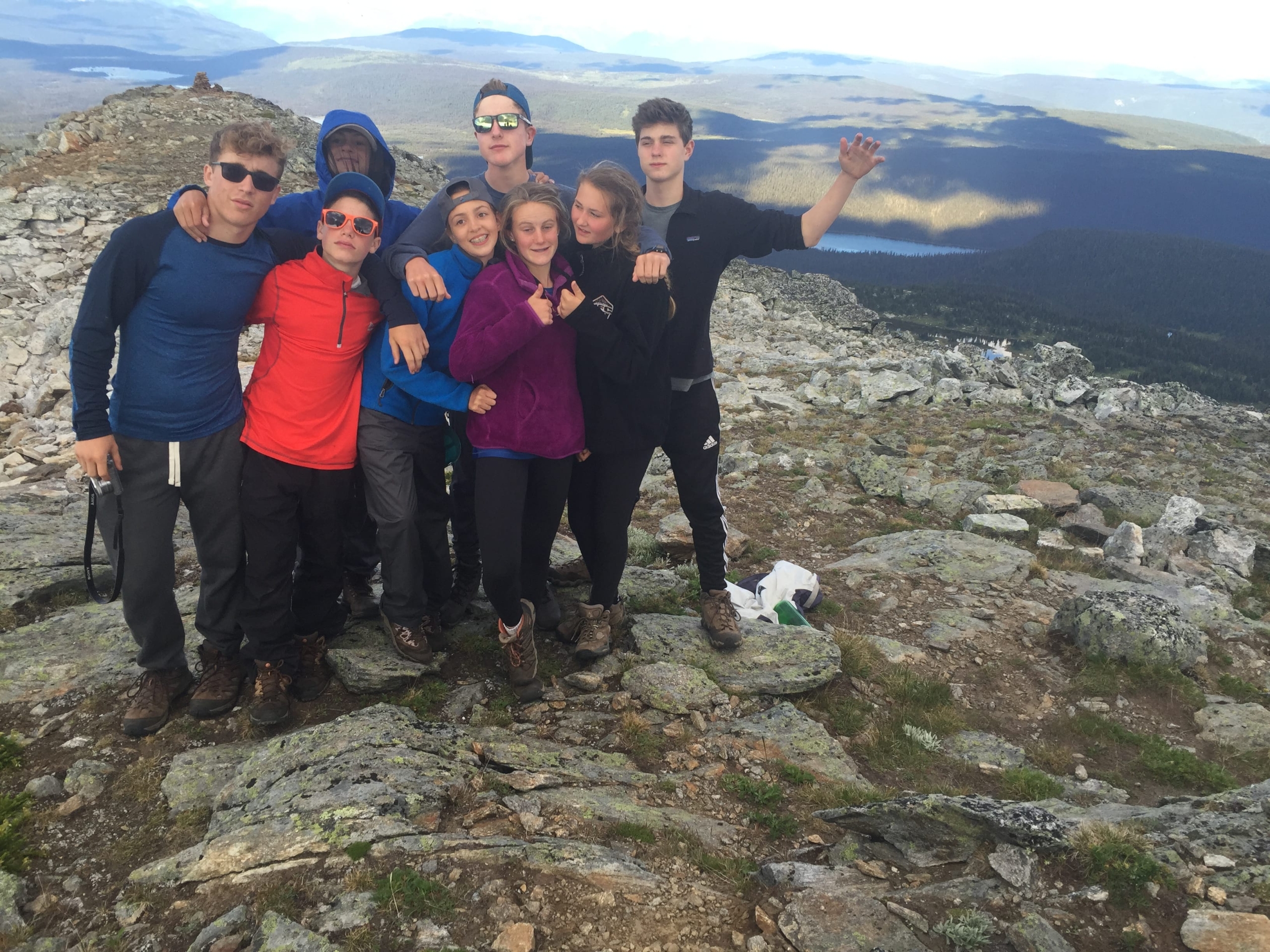
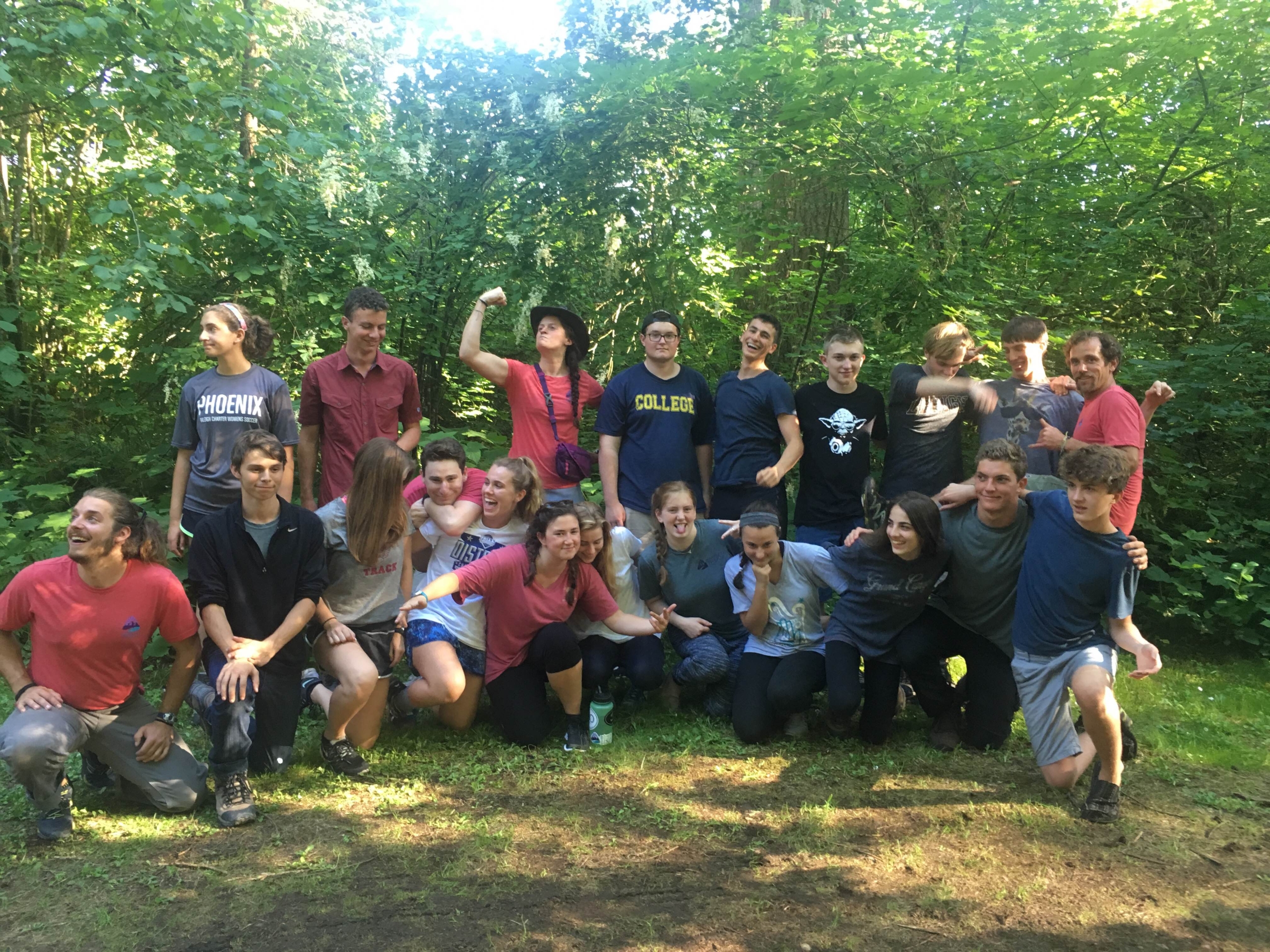
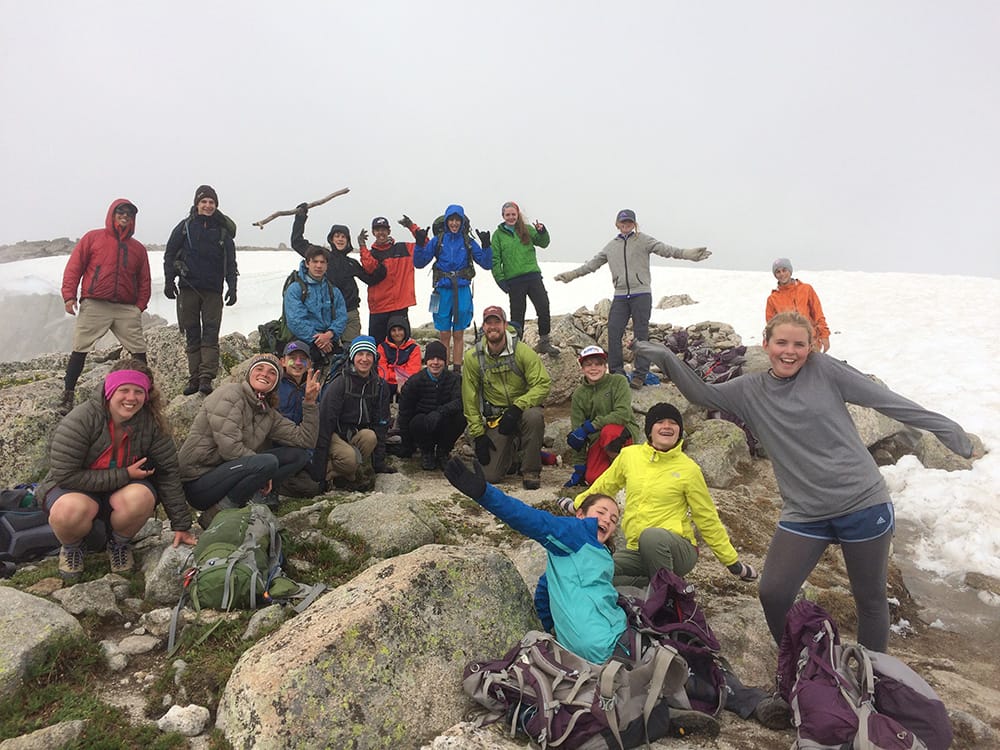
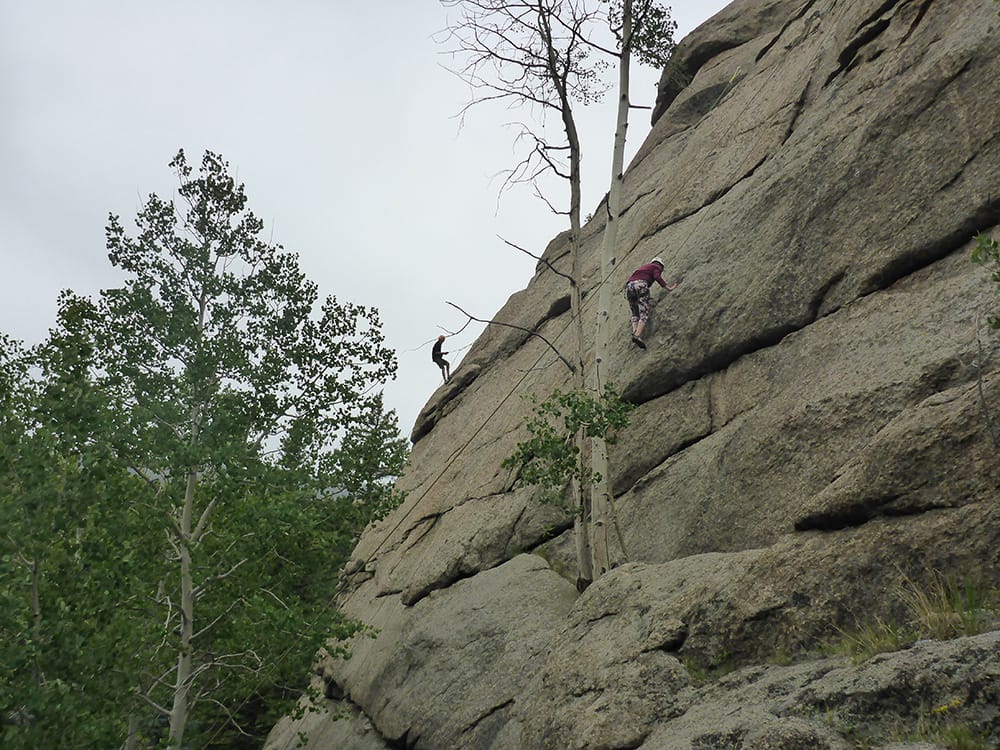
Everyone is on the move! When the last planes land in Alaska, today we will have 215 students scattered between Alaska, California, Oregon, Washington, Wyoming, and Colorado. It’s been exciting to welcome our students, and the fun, adventure, and community that makes Adventure Treks special has finally begun!
After opening these first round of trips, our directors converge at our base camp in southern Washington for our second orientation, or “small O,” to welcome the trip leaders and instructors of our Alaska Expedition 2 and California Challenge 2 trips. Every instructor goes through between two and three weeks of training before they greet their students; check out our 2017 instructor orientation video below:
After small O, our directors will be visiting trips, supporting instructors, and getting to know as many students as we can. This is a fabulous group of students and after months of preparation, we are so excited the summer is finally here!
https://d52gwxhjtzjcm.cloudfront.net/2025/01/small-o-blog.jpg5891073AT Staffhttps://www.adventuretreks.com/wp-content/uploads/2025/02/AT-logo-white-NEW.pngAT Staff2017-06-27 13:15:522025-12-28 16:41:15Adventure Treks is Open for Summer!
Greetings from 2017 Adventure Treks instructor orientation! About 50 instructors converged from 21 states and Australia for two weeks of training as we eagerly prepare for the arrival of our students. And let me tell you: It’s great to be back in full Adventure Treks mode again! As your kids will tell you, life is better at Adventure Treks than it is out in the real world. Excitement, kindness, community, competence, commitment, and impressive role models are just a few words I would use to describe the vibe as our instructors greeted each other on the opening day of orientation.
This is a great group of instructors. We have a 62 percent return rate, an average age of 26.8, and an average three-year tenure of Adventure Treks experience each. More important, our instructors are committed to using the joy and excitement of the outdoor adventure experience to facilitate personal growth, strong friendships, and a close community living experience.
Our instructors have graduated from a variety of fantastic colleges, including Cornell University, University of Pennsylvania, Middlebury College, Johns Hopkins University, Elon University, Wesleyan College, Colgate College, Bates College, University of New Hampshire, University of North Carolina at Chapel Hill, University of Vermont, University of Colorado at Boulder, Depauw University, Appalachian State University, Colorado College, Bucknell College, Davidson College, Virginia Tech, Ohio State University, Indiana University, Hobart College and several more.
The first week of instructor orientation will be spent together, camping as a large group in southern Washington. Here we review Adventure Treks’ safety policies and procedures and build a close community that emphasizes kindness and inclusion. This “big group” orientation will be followed next week with trip-specific training, where each five- or six-person instructor team travels together to their region, scouts trailheads, meets with outfitters, and learns the details of their specific trips. Meanwhile, they bond as an instructor team, plan meals, and eagerly await the arrival of their students.
Our leadership team—11 trip leaders and our directors—has already been here for a week. They gathered in a cabin near Mt. Hood on June 1 to set the tone for the summer and get on the same page for leading consistent and excellent trips. They hail from 11 different states, average 27 years old, and have 107 collective years of Adventure Treks experience, with an average of 7 seasons of AT experience each. (Two were even former Adventure Treks students!) I’m proud to be a part of this group of mentors who will be helping train our new instructors at orientation and overseeing the success of our trips.
So what do we do at orientation? We form our instructor team community by modeling the Adventure Treks philosophy for the instructors who are joining us for the first time. We apply leadership theory, current child psychology, and recent developments in brain science to the learning elements in our trips. We also focus on the specific details of each itinerary, and we use this time to review safety, driving, and policies and procedures. We look at ways we can use the natural disruption of these unique outdoor experiences to enhance our learning objectives (our Great 8 Outcomes) and build independence and confidence. We seek out ways to make the great outdoors even more fun than social media and video games! We share the tips and tricks we’ve gleaned over the years as we work hard to make every trip consistent, exceptional, and even better than previous years.
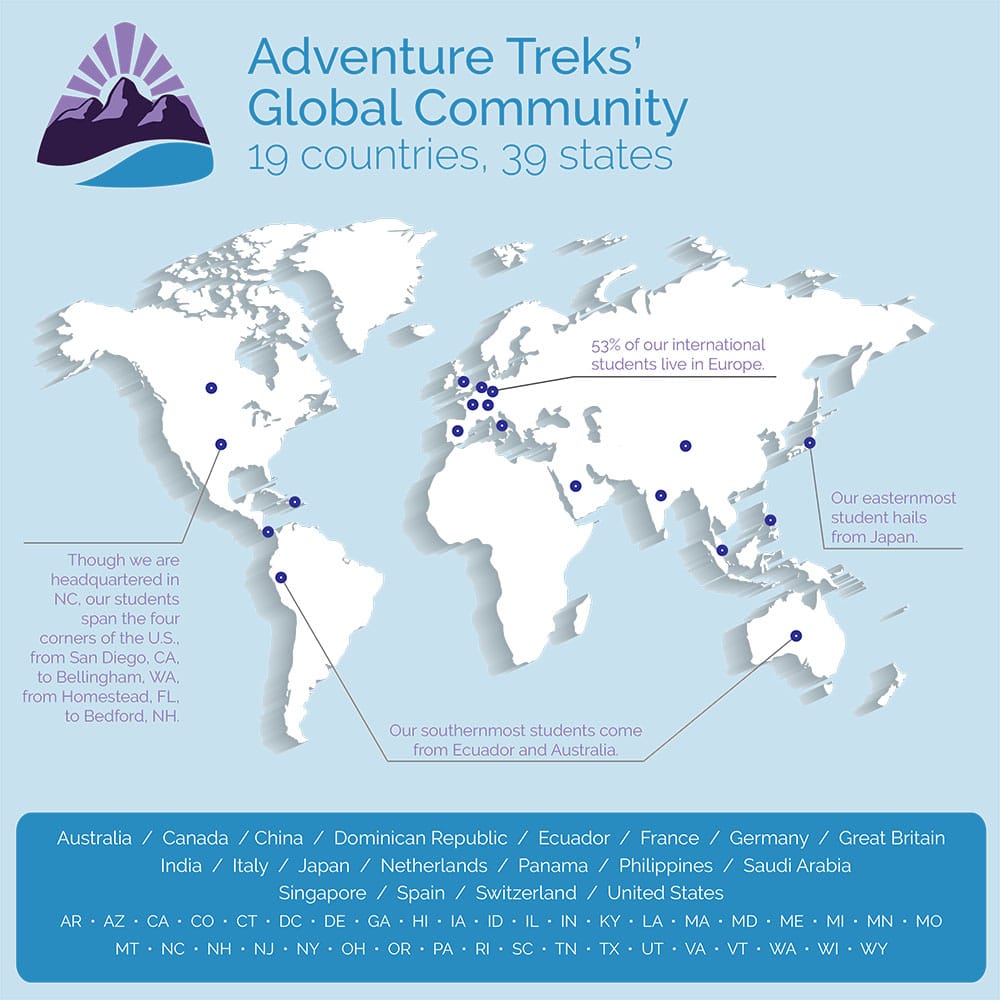
Every year, Adventure Treks welcomes students from all over the United States and even the world. So far in 2017, our student population comes from 39 states and 19 countries!
We appreciate having this diversity on all of our trips, and we know the students truly enjoy getting to know others from different cultures and backgrounds. Through the welcoming communities and exciting, fulfilling outdoor activities on our trips, the students easily find common ground and quickly make great, long-lasting friendships.
Below, see where our 2017 students come from.
Our map may expand as we add our last few students. This year, our home state of North Carolina rose to the top as our most-represented state! Second in line is New York, followed by Florida, California, and Georgia. (We’re still waiting on a student from North Dakota!) Regardless of your native country, state, or tongue, we are so excited to see everyone on opening day!
https://d52gwxhjtzjcm.cloudfront.net/2025/01/Global-community-blog-2017-1000.jpg10001000AT Staffhttps://www.adventuretreks.com/wp-content/uploads/2025/02/AT-logo-white-NEW.pngAT Staff2017-05-17 19:51:152025-12-28 16:41:22A Look at Our 2017 Global Community
Congratulations to our graduating class of 2017, soon to be the class of 2021! We are always impressed—but never surprised—at the remarkable colleges Adventure Treks students will soon be attending. Below is the list of the colleges that you, our students, have chosen.
We feel privileged and grateful to have been a topic of many of our students’ college essays. We know that navigating through the college “sorting hat” has been difficult, and we want to applaud every one of you for all the hard work you have put into your successful high school careers.
We thought we would share an excerpt from former student Eli Burk’s acceptance letter from the University of Rochester: “For a major research university to thrive with just 5,300 undergraduates, each student has to make a personal and immediate contribution to campus life. The counselors recommended you for admission because of the lessons you learned from your experience climbing Alaska’s Matanuska Glacier. The committee and I are confident you will both stand out and grow stronger as part of the Rochester family.”
We’re so happy that you all have chosen schools that are a good fit for your personalities, abilities, and interests. We’d like to emphasize that what you will take away from your college experience has little to do with the prestige or rank of a given college, and everything to do with the mindset and attitude with which you approach your collegiate career. Success in college is about the effort poured into the experience, your desire to fuel your passions, the relationships formed with new friends and faculty, and your ability to thrive in new and sometimes ambiguous situations. We urge you to form relationships with faculty, while it can be more difficult than getting to know your AT instructors, these relationships are a key indicator of what makes a successful college career!
At a time when only 58 percent of students at four-year colleges graduate within six years, and many needing some kind of psychological counseling during their first year at school, we’re proud that the graduation rate of Adventure Treks students remains consistent at 98 percent! We believe the resilience, social confidence, collaboration, and community mindset skills you’ve strengthened through your Adventure Treks experiences will help you thrive in college (and the world beyond).
Having talked to dozens of our graduates currently in college, here are some examples of how the Adventure Treks experience helped them prepare for college life:
“AT did a phenomenal job preparing me for the transition to college. I had the ability to adapt to new and changing situations. I knew how to meet friends and how to work with different kinds of people. I have seen many of my friends struggle with the transition, but it’s been easy for me.” – Christopher, University of Richmond
“AT made me more comfortable in my skin; when I got to college, I didn’t have to try to be anybody but myself. It was refreshing and empowering.” – Max, Stanford University
“At AT, you learn how to help out and look out for others, how to thrive when things aren’t easy, and how to see a bigger picture beyond yourself. AT gave me the confidence to lead a school organization my freshman year, and it means I am always the one doing more than my share in project groups.” – Jake, University of Nevada, Reno
2017 Adventure Treks Freshmen
Stephen Yan, Princeton University
Jack Kanzler, Tulane University
Ethan Kugler, University of Florida
Logan Branagh, University of Sydney, Australia
Hannah Petersen, Georgia Institute of Technology
Harper Swing, University of North Carolina, Chapel Hill
Jennifer Jacober, University of North Carolina, Chapel Hill
Laura Glanz, Washington University in St Louis
Alana Bojar, Washington University in St Louis
Rudy Sutton, Union College
Rebecca Carroll, US Navy
Eli Hess, University of South Carolina
Suzy Weiner, University of Montana
Maria Rodriguez, Davidson College
Rafi Derringer, University of Southern California
Harrison Tankersley, University of Colorado, Boulder
JD LeRoy, University of Southern California
Sam Miller, University of Colorado, Boulder
Eli Burk, University of Rochester
Noah Ayers, Southern Methodist University
Brian Kreidberg, Hofstra University
Olive Welsh, Colorado College
Lauren Brodsky, University of Pennsylvania
Aaron Segal, Ithaca College
Holden Bradley, University of Colorado, Boulder
Ben Garelick, University of Virginia or Emory
Henri Emmett, Bates College
Krystin Langer, University of Iowa, School of Journalism
Eli Hess, University of South Carolina
Sam Pollack, Wesleyan University
Jayson Butts, Wheaton College
Spencer Butts, Hobart and William Smith Colleges
Lydia Welp, Quest University, BC Canada
Julia Woodson, University of Michigan
Madison Coleman, Auburn University
Matt Zenko, Ohio State University
Sam Lewis, Colorado School of Mines
Amara Cohen, University of Chicago
Oliver Holden-Moses, Northwestern University
Isabel Coletti, University of North Carolina, Asheville
Evan Nagareda, Northwestern University
Stephen Yan, Princeton or University of Chicago
Josh Martelon, University of Colorado, Boulder
Davis Wain, Gerogia Technical College
Sydney Kay, Ithaca College
Zach Zionts, Hobart and William Smith Colleges
Joey Michael, University of Colorado, Boulder
Sammie Hasen, University of Colorado, Boulder
Jamie Leonard, Fort Lewis College
Anna Gottesman, University of Michigan
Martin Capriles, Boston University
Kyra Wilkowski, University of Rhode Island
Ryan Grinnell, University of California, Berkeley
Ben Fertik, Purdue University
Nicholas Hopkin, University of Michigan
If we missed you, please tell us where you are heading so we can add you to this list and put you in touch with Adventure Treks students already at your new school!
https://d52gwxhjtzjcm.cloudfront.net/2025/01/College-blog-photo.jpg7501000AT Staffhttps://www.adventuretreks.com/wp-content/uploads/2025/02/AT-logo-white-NEW.pngAT Staff2017-04-24 19:46:582025-12-28 16:41:22College 2017: Where Our Students are Headed Next
Many people ask us why we don’t offer community service trips, and specifically international ones, as part of our summer trip offerings. We could make a lot of money if we chose to do this. However, we would feel guilty making money on something we believe rarely accomplishes most of its intended goals.
Don’t get us wrong—we are firm believers in community service. Folks in our office are vitally engaged in our community, from volunteering for Big Brothers Big Sisters to serving on local and national environmental and conservation boards. We do this volunteer work on top of our real jobs, and we know many of our families carry similar commitments.
It all goes back to a theme I learned in college—think globally, but act locally.
Volunteerism on the local level has a powerful effect, even for middle and high schoolers. It costs nothing but time, and you can see the direct result of your actions. Teens who volunteer locally begin to understand how government and non-profit groups intersect to build effective, cohesive, and functional communities and care for vulnerable and disadvantaged citizens. Engaged local citizenry is the foundation of a democratic society and can build connections that last a lifetime. At a time when many students tend to be self-absorbed, through volunteering, they can discover new passions, build empathy, and discover how they can affect the causes they care about.
We do not see these same long-term benefits with international community service trips, also known as “voluntourism.” Demand for community service trips began in the early 2000s when many high schools started requiring community service hours in order to graduate. These same kids worked so hard during the year and then used summers to fulfill volunteer hour requirements. The belief and intention was that service would create “better kids” with a wider perspective. This coincided with a time when college admissions were becoming more competitive. Unique community service trips became perceived as a way to differentiate a college application. And a new summer industry was born.
Though we have watched many other programs shift their focus from outdoors to community service over the last 15 years, we’ve declined to follow the market. And here is why: All of the research and literature demonstrates that community service trips are rarely impactful on anyone but the individual taking the trip. (Unless the volunteer is bringing a specific skill to a community in need (doctor, engineer, or architect) or doing relief work after a natural disaster.)
Having read scholarly articles about the costs and benefits of voluntourism, below is the synopsis.
The benefits disproportionately favor the volunteer rather than the community that is being helped.
The lasting impact of most tasks performed by volunteers is often negligible and sometimes even negative.
Members of local communities may find volunteer tourism offensive. (How would you feel if 20 “foreigner teens” descended on your neighborhood to “help?”
These trips are expensive, and the benefits would often be greater if the participant stayed home and simply invested the tuition and travel money directly in an effective non-governmental organization (UNICEF, Doctors Without Borders, etc.) in the host country.
A nonstop cycle of volunteers can promote a cycle of dependence in the host country.
There is a big difference in the impact between skilled (doctors and engineers) and unskilled (teenagers) volunteers.
This can promotes an unhealthy “western savior complex.”
Here are a few articles to consider from NPR, Reuters, Forbes, CNN, and Newsweek (there are many more out there).
Trips like these do serve the participants, if not the intended communities. They can indeed be “life-changing experiences.” But if a life-changing experience is what the participant seeks, we believe an outdoor adventure experience is a even more effective way to grow. Research (see this Columbia University article and this Washington Post article) also shows that college admissions departments feel the same way about voluntourism and give little credence to these paid community service experiences. (But they give a lot of credit to applicants who volunteer locally for causes about which the applicant is passionate.)
At Adventure Treks, young people grow in numerous ways. They gain confidence, independence, and resilience, and improve communication and collaboration skills. They gain the benefits of living and working in a close community and make friends from around the world. Arguably, these same goals could be obtained from a community service trip, but we feel our delivery system—the outdoors, tech-free, challenge through strenuous and new activities—is a far more effective vehicle for growth than a paid community service trip. And this is why we decline to do these community service trips. We want to do one thing, we want it to be highly effective, and we want to do it extremely well. For us, it’s outdoor education.
https://d52gwxhjtzjcm.cloudfront.net/2025/01/BC1-16-160-cropped-e1675358595956.jpg480995AT Staffhttps://www.adventuretreks.com/wp-content/uploads/2025/02/AT-logo-white-NEW.pngAT Staff2017-04-03 16:22:042025-12-28 16:41:22Our View on Service Trips – And Why We Don’t Offer Them
While at Adventure Treks, students learn how to cook delicious meals in the wilderness. This helps students get more involved in the preparation and planning aspects of their trips, and it teaches them lifelong skills. There is a strong sense of pride that comes from creating a hot meal in a serene wilderness environment. Students and parents often wonder what type of food we eat at Adventure Treks trip. Here are a couple of classic meals that each trip cooks and prepares. Our hope is that the meals students make at AT become regular meals that they cook at home for their family!
Breakfast
For some people, “cooking” breakfast is easy: Grab a carton of milk and a box of cereal. At Adventure Treks, we like to spice up our breakfast options! On a few hectic days, we might have a cold breakfast, but we always strive for hot breakfasts with lots of vegetables, meat, and a vegetarian option. Here’s one of my favorite options—I’ve cooked this on every AT trip I’ve led.
Breakfast Burritos
Ingredients
Salsa
Peppers
Spinach
Avocado
Sausage or bacon
Veggie sausage
Black beans or refried beans
Cheese
Eggs
Tortillas (flour or corn)
Hash browns
Hot sauce / spices
Cooking spray
Lunch
We try to get creative with our lunch options at Adventure Treks. Healthy wraps with lots of fruit and snacks are a staple! Chicken Caesar wraps is a favorite meal of mine that we eat at least once on each Adventure Treks trip.
Chicken Caesar Wrap
Ingredients
Grilled chicken or pre-cooked chicken
Tofu or another meat alternative
Tortillas (flour or corn)
Lettuce
Spinach
Cucumbers
Baby tomatoes
Shredded cheese
Croutons
Caesar or Goddess dressing
Chips, pretzels, or veggie sticks
Grapes, clementines, watermelon (one or two fruit options)
Dinner
Students have more time during dinner to cook elaborate meals and learn new skills in the backcountry “kitchen.” During dinner, students often divide up into groups and each cook one item. We then come together in the large group to eat the meal as a community. Other times, a few students will volunteer to cook dinner while others help set up camp. This gives students who like to cook more opportunities to test out their skills. Cooking is a great way to get students involved, and it helps build solid communities. We cook stir fry in some form during every trip. It’s an awesome meal that students learn quickly!
Teriyaki Stir Fry
Ingredients
Teriyaki sauce (soy sauce also works)
Garlic
Onions
Carrots
Snap peas
Broccoli
Zucchini
Water chestnuts
Baby corn
Chow mien noodles (fun to sprinkle on top)
Pre-grilled chicken or steak
Minute Rice (Minute Rice is nice for a large group in the woods, but any rice works at home)
Snacks
Who doesn’t love snacks?! We always have snacks at Adventure Treks. We know that students are more active, in a new environment, and get hungry more often throughout the day. Each day, we offer multiple snack options: usually fresh fruit, peanut butter pretzels, Goldfish, hummus and carrots, etc. A classic snack that we eat on each trip is GORP (or Good Old Raisins and Peanuts). We have definitely added a few items over the years! Here is a list of ingredients that we use to create different versions of GORP.
GORP
Ingredients
Raisins or craisins
Peanuts or mixed nuts
M&Ms or peanut M&Ms
Dried fruits
Chocolate-covered raisins
Reese’s Pieces
Yogurt-covered raisins
Pretzels
Goldfish
Dessert
A tasty treat can go a long way after a hard day. We like to end the day with a sweet resolution. One of my all-time favorites is Worms In Dirt. It sounds weird at first, but check out the ingredients below!
Worms In Dirt
Ingredients
Chocolate/vanilla pudding
Milk
Crushed Oreos
Gummy worms
Oreo pie crust
Each student at Adventure Treks has their own favorite meal. We hope that students leave the trip with a new recipe that they love to make and new culinary skills that stay with them for life! If you have any favorite outdoor recipes please share them with us! We love to hear about different, fun food creations!
https://d52gwxhjtzjcm.cloudfront.net/2025/01/Breakfast-Burritos.jpg340340AT Staffhttps://www.adventuretreks.com/wp-content/uploads/2025/02/AT-logo-white-NEW.pngAT Staff2017-03-13 18:08:292025-12-28 16:41:22Meals at Adventure Treks: From the Outdoors to Your Kitchen
Joe on Mt. Olympus during the Leadership Summit trip.
As some of you may know, Josh Goldbach, our associate director, has moved on from Adventure Treks. After six years with us, Josh decided that while he did not want to leave AT, he did want to try on a new hat. He is still a part of the Adventure Treks family, and has been helping with staffing and new ideas for our upcoming 2017 season. While we miss having Josh in our office and are thankful for all of his hard work, we are excited to welcome Joe Sisti as the new staffing director. Some of you may already know Joe as one of our students’ (and staff’s!) favorite Adventure Treks instructors
Originally from Virginia, Joe received a bachelor’s degree from Virginia Tech. Instead of playing football, he decided to focus his time in the outdoors, and has since become an accomplished outdoor educator, rock climber, skier, and mountain biker. Joe has been working with Adventure Treks as an instructor, then a trip leader, and then our educational programs director for the past five years. So you all can get to know Joe a little better, he answered a few questions for us.
What’s your favorite AT activity? It’s not the most exciting on paper, but the backpacks are the best. Biking and climbing are exciting, but I feel like the real moments that make AT what it is happen on our backpacks. Everything changes once you leave the trailhead. You get time to settle down and take it all in. The hours on the trail allow everyone to have great conversations and get to know one another. After a few days of this, the guards come down and everyone is able to be themselves. You play tons of games and work together to get all the little chores done so you can have more time to enjoy the views, talk, or just hang out in nature. Backpacking with AT students is great, and most of the time, I forget I’m even working.
Joe on the Lost Coast during a California Challenge trip.
What made you want to work as an outdoor educator? I had some pretty tough times in college, and I really struggled to find my path. I had no idea what I wanted to do for a job or career. The one thing that seemed to make my worries go away was going for hikes in the mountains around Blacksburg. The Appalachian Trail runs pretty close to town, so there are tons of opportunities for great hikes. One day while outside, I thought, “I wish this could be my job.” After doing a little research and getting some helpful advice from my manager at Domino’s Pizza (I had a brief stint as a delivery boy), I took a NOLS course in Wyoming whereI spent nearly 30 days in the backcountry. I had never felt so good. One of my instructors, Claire Parrish, really inspired me. She was such a competent outdoorsperson—tough and strong—but also the most positive person I had ever met. She made brutal hikes through steep terrain a blast. I realized I wanted to be her. I thought if I could have the impact on at least one student the way she did with me, it would be worth it.
What’s your favorite AT memory? There are lots, but two come to mind immediately. In summer 2016 while on Leadership Summit, we stopped at Goodwill to purchase some summit flair before climbing Mt. Olympus in Washington. All of the students purchased purple clothing, and we held an impromptu purple prom at our group campsite in Sequim Bay. It was better than any prom I attended in high school, and I realized, once again, that the students who come to AT truly are special: inclusive, fun, and totally willing to be their weird selves. I loved it. The second one occurred on a backpack in the Trinity Alps in California. We made camp early due to some tough conditions, and to pass time, we played loads of games, wrote a group poem, and took a swim in an alpine lake. The icing on the cake, though: acting out books one through three of Harry Potter. There were only four of us involved, and the group asked us to stop at three, but there are not many times I can remember having more fun in the woods.
Joe showing off his AT colors in Colorado.
What keeps you coming back to AT? The people: the students, the instructors, the directors I get to work for. Our trips are great, and I haven’t had a course area at AT that wasn’t spectacular. Dock [John Dockendorf], though, has truly created something special at AT. It really is a second family. My friends there know me better than anyone else; they have seen me at my best, and also at my not-so-best, and they still love me. That’s a pretty rare thing to come across these days: total acceptance for who you are. At the end of a season, I think most people involved with AT feel that way, students and instructors alike.
What’s something unique about you? If we are talking about quirks, I could go on for a while. I’ll choose two. I love Reuben sandwiches. I have had one in every new place I have traveled to. I lost count of how many I have tried in how many restaurants, but the best one can be found at Choice City Deli in Fort Collins, CO. Seriously, I’ve tried them all over America and the corned bison Reuben there is just the best. I also have an odd connection to writing utensils. The pen I am currently using has been with me for nearly three years now. I can’t stand losing them.
Thank You for Being Late by New York Times columnist Thomas Friedman is the most powerful book I have read this year, and it does an outstanding job of explaining the current state of the world and the “accelerators” driving the insane pace of change. Friedman’s accelerators include Moore’s Law, Big Data, the markets, population growth, and global warming—all whose effects are expanding exponentially. At this point, the pace of change has exceeded most humans’ ability to adapt.
Throughout the book, Friedman points out suggestions to help one thrive in the years ahead. Without knowing it, he makes a compelling case for the Adventure Treks experience by emphasizing the importance of three of our most defining outcomes:
1. Time to reflect
By temporarily removing kids from their busy, tech-filled lives, Adventure Treks provides a natural environment where students have the opportunity to be alone with their thoughts and reflect on their place in the world. “To whiz through our obligations without time for a single mindful breath has been a model for a successful life,” Friedman writes. But a pause is important; wisdom comes through reflection, and we are building a world that isn’t giving anyone the time to turn information into wisdom. “Not everything is better faster or meant to go faster.”
An extended break, surrounded by wilderness, is a unique opportunity to realize what is most important and help choose, how in our terms, we want to fit in with 21st-century life.
2. The 4 C’s
Intelligence used to be defined by the breadth of what we knew. Now, with the advent of artificial intelligence, information is becoming a commodity—and intelligence is instead knowing what questions to ask. “Not only are we required to think both inside and outside of the box, but now we need to be prepared when there is no box at all,” writes Friedman. While technological skills are important to thrive in this accelerating and changing world, Friedman emphasizes the importance of “stempathy skills,” which include the ability to communicate, collaborate, empathize, flourish with uncertainty, and think creatively and critically. Friedman notes that the only occupations that have shown consistent wage growth since 2000 require not only cognitive skills, but, more important, strong social skills.
Friedman implores educators to focus on the 4 C’s (communication, collaboration, creativity, and critical thinking—and to this he adds coding); these line up with what the research and advocacy by the Partnership for 21st-century skills. He emphasizes that these 4 C’s are not innate skills, but ones that can be taught. He warns that any skill without a strong human component will be replaced by computers or robots. We feel, and research from University of New Hampshire on Adventure Treks supports, that there are few better ways to improve one’s communication, collaboration, creativity, and pro social skills than an Adventure Treks outdoor experience.
4. The importance of community
In a technological world, we spend a lot of time in cyberspace where there are essentially no rules. There is a general feeling that the world is becoming less stable and that fewer people know the “rules” of living in society. If we want society to remain stable, Friedman emphasizes the importance of community, character, and values, and knowing how to live as a contributing member to one’s community. Anthropologically speaking, humans are meant to live in a community, and studies show that we are happier when we are connected to others. Relationships are the hallmark of the human experience, and they can only be nurtured with time. Our ability to forge human relationship is a unique human capacity and is what separates us from nature or machines.
Friedman affirms that character is rarely an individual accomplishment; rather, it emerges through “joined hearts and souls and in a group.” Our focus at Adventure Treks is “cultivating the intense, thick community” that Friedman and David Brooks emphasize. Once students have experienced the power and joy of a close community experience, they seek it out elsewhere and facilitate community in the groups they work and live in. A strong community experience provides important grounding in a constantly changing world.
As the world becomes more technological, we feel a great way to build skills to thrive in this world is to actually take a break and spend time outside with friends. While our students are having fun in the outdoors, they come home with a skill set that better prepares them to thrive in this new age of accelerators.
https://d52gwxhjtzjcm.cloudfront.net/2025/01/CC1-16-14-600.jpg600600AT Staffhttps://www.adventuretreks.com/wp-content/uploads/2025/02/AT-logo-white-NEW.pngAT Staff2017-02-07 18:12:192025-12-28 16:41:22Adventure Treks in the Age of Acceleration
My son Thomas (far right) had a blast on his third AT trip to British Columbia.
The holidays and first round of exams are in the rear view mirror. Because the days are shorter and school dynamics help everyone get more into the academic groove, our teens are spending less time playing outside. They begin to relax into a slumber of sorts regarding the outdoors world that they so enjoy in the summer.
For some, the magic of last summer seems so far away, and a disconnect of sorts begins to seep in. You may hear your child say something like, “I’m not sure I want to do that trip this summer.” It’s normal for our kids to voice reluctance about things that they were so sure about just months ago. Part of it is the confidence in themselves to once again rise to the challenge, taking steps into an unknown or unclear arena. Listening to them, helping them process, and validating that they are nervous can help ease that anxiety. Little reminders like helping them get in shape is always a good idea. Make it fun—go for a hike this weekend, even if that is just a stroll around the lake or a long walk with the dog. Break it down and try to figure out where the ominous feeling comes from. My two kids (ages 15 and 17, who have done a total of nine trips) tend to think the bonds they formed the past summer won’t be the same or as good this summer. Remind them about the richness of showing up and finding out the back stories of each person and how fun it can be—kind of like opening a gift that you have no idea what’s inside.
My daughter Sarah (bottom row, middle) could not have had a more fun or fulfilling time on Leadership Summit this year.
After completing the Alaska trip in 2015, my daughter was certain she didn’t want to continue to Leadership Summit. We talked about it several times through the school year, and even looked up her friends who would be attending. It wasn’t until May that she approached me to ask if she could go on Leadership Summit. At that point, it was of course full, which was a great disappointment to her. And the only reason she got to go was because of a last-minute cancellation. But I think she realized, as it got closer to summer, how much she would miss her Adventure Treks community—especially after five incredible trips.
On the way to school this morning, my son and I noticed a lot under construction near our house that was muddy from all the recent rain. We both remembered how he used to play in the mud and loved it. He asked, “how could that have been so much fun then?” Maybe because it was simpler and you didn’t care who was watching or how you looked, you just played.
That mysterious zone between childhood and adulthood has so many gray moments. Our teens often think: Which am I—a kid or an adult?What would people think? How do I look? These thoughts are all pretty common, but they’re also very constricting and confusing at times. Our kids want to have fun, love the outcome of connected community, and appreciate and cherish the feeling of being able to do more than they thought they could. But while their memories are a bit faded, returning to this experience may feel overwhelming. So if your kids are getting cold feet, remember that it is to be expected. They are doing their job. It is a good thing that they don’t just jump into something without thinking it through. That is a skill we all hope they will utilize throughout their lives.
https://d52gwxhjtzjcm.cloudfront.net/2025/01/img_0227-scaled.jpg19202560AT Staffhttps://www.adventuretreks.com/wp-content/uploads/2025/02/AT-logo-white-NEW.pngAT Staff2017-01-30 16:40:032025-12-28 16:41:22Cold Feet about the Summer is Normal
Becoming “experts” together on our first mountain summit!
Getting acquainted with outdoor activities can be both challenging and intimidating. There are a lot of factors to consider, especially if you are new to the outdoors. But it doesn’t have to be scary! Our first recommendation: Do not make being a beginner one of those factors.
We’re all beginners at some point. But when we first try a new activity, sometimes thoughts of inadequacy creep up within us. During my first extended outdoor experience on a seven-day backpack trip in Pisgah National Forest, I fell in love with the sense of self-awareness and calmness I achieved—even though it was my first time ever wearing a heavy pack! But I also thought, “I will conquer this new skill to be a master, and only then I will truly receive the benefits of the outdoors.” It has taken me a long time to realize that being the best at something, or at the very least surpassing “beginner status,” is not the reason to go out into nature—and is not the only way to receive benefits from nature.
In fact, the whole reason I was flocking to the wilderness was to find some peace from the constant competition in my daily life. We are immersed in a culture that values performance. In education, career advancement, even the local rock climbing gym, there is a looming presence of competitiveness. It is hard not to engage in this culture, and instead simply enjoy being outside. I felt torn and confused: I began engaging in that competitive culture outside, though I was going there in the first place to specifically avoid it. It’s hard to break free of something so ingrained in us, though, even in the wilderness. I started to make an intentional effort to focus more on enjoying the experience of being surrounded by nature, and working toward getting to know myself and my fellow companions. I tried to think less of how far or fast I went, and think more about what it felt like to climb over a mountain ridge or walk silently in the forest. I had enough outdoor skills to keep myself safe, of course, and loved learning new tricks from fellow backpackers, but I stopped comparing myself to other people (the “masters”). Think about what Theodore Roosevelt said: “Comparison is the thief of joy.”
Rock climbing for the first time.
If I could give one piece of advice to Adventure Treks students, it would be to not let fear of being new at something prevent you from having a wonderful experience in the outdoors. Many of our students come to Adventure Treks having never backpacked or rock climbed or whitewater rafted. It is not until the second day or so that they realize that most of the other people on the trip are in the same boat! Instructors teach students everything they need to know throughout the entire adventure, and by trip’s end, students usually aren’t beginners anymore—without any help, they can set up a tent, clean up camp, tie a figure-eight knot, pack their backpack, and much, much more.
As my love for the outdoors continues to grow, so does my desire and capability to learn and improve on new outdoor skills. For teenagers and adults alike, this is a great way to build confidence and increase your comfort level in both the wilderness and at home or school. I make more of an effort now to focus on my mindset and intention when I’m learning new outdoor skills. My goal is to not let my fear of “looking weird” or not being good at something prevent me from having an awesome outdoor experience. Living by this sentiment has greatly increased the quality of my outdoor experiences and my happiness.
We may request cookies to be set on your device. We use cookies to let us know when you visit our websites, how you interact with us, to enrich your user experience, and to customize your relationship with our website.
Click on the different category headings to find out more. You can also change some of your preferences. Note that blocking some types of cookies may impact your experience on our websites and the services we are able to offer.
Essential Website Cookies
These cookies are strictly necessary to provide you with services available through our website and to use some of its features.
Because these cookies are strictly necessary to deliver the website, refusing them will have impact how our site functions. You always can block or delete cookies by changing your browser settings and force blocking all cookies on this website. But this will always prompt you to accept/refuse cookies when revisiting our site.
We fully respect if you want to refuse cookies but to avoid asking you again and again kindly allow us to store a cookie for that. You are free to opt out any time or opt in for other cookies to get a better experience. If you refuse cookies we will remove all set cookies in our domain.
We provide you with a list of stored cookies on your computer in our domain so you can check what we stored. Due to security reasons we are not able to show or modify cookies from other domains. You can check these in your browser security settings.
Other external services
We also use different external services like Google Webfonts, Google Maps, and external Video providers. Since these providers may collect personal data like your IP address we allow you to block them here. Please be aware that this might heavily reduce the functionality and appearance of our site. Changes will take effect once you reload the page.
Google Webfont Settings:
Google Map Settings:
Google reCaptcha Settings:
Vimeo and Youtube video embeds:
Privacy Policy
You can read about our cookies and privacy settings in detail on our Privacy Policy Page.

 Breakfast Burritos
 Chicken Caesar Wrap
 Teriyaki Stir Fry
 GORP
GORP Worms In Dirt
 Thank You for Being Late by New York Times columnist Thomas Friedman is the most powerful book I have read this year, and it does an outstanding job of explaining the current state of the world and the “accelerators” driving the insane pace of change. Friedman’s accelerators include Moore’s Law, Big Data, the markets, population growth, and global warming—all whose effects are expanding exponentially. At this point, the pace of change has exceeded most humans’ ability to adapt.
 1. Time to reflect
 4. The importance of community