Originally published April 15, 2022. Updated and reposted April 8, 2026.
An interesting theme sprouted up this month when I asked our team to recommend some of their favorite books! The stories of all three of the titles listed below circulate around environmental action, though the message is incorporated in diverse ways. Braiding Sweetgrass is non-fiction with a focus on indigenous knowledge, The Overstory is solemn and conspicuous in its argument for the preservation of forests, and Project Hail Mary is a surprisingly intricate take on climate change through the lens of digestible science fiction. Below, read the Adventure Treks’ team take on their latest reads!
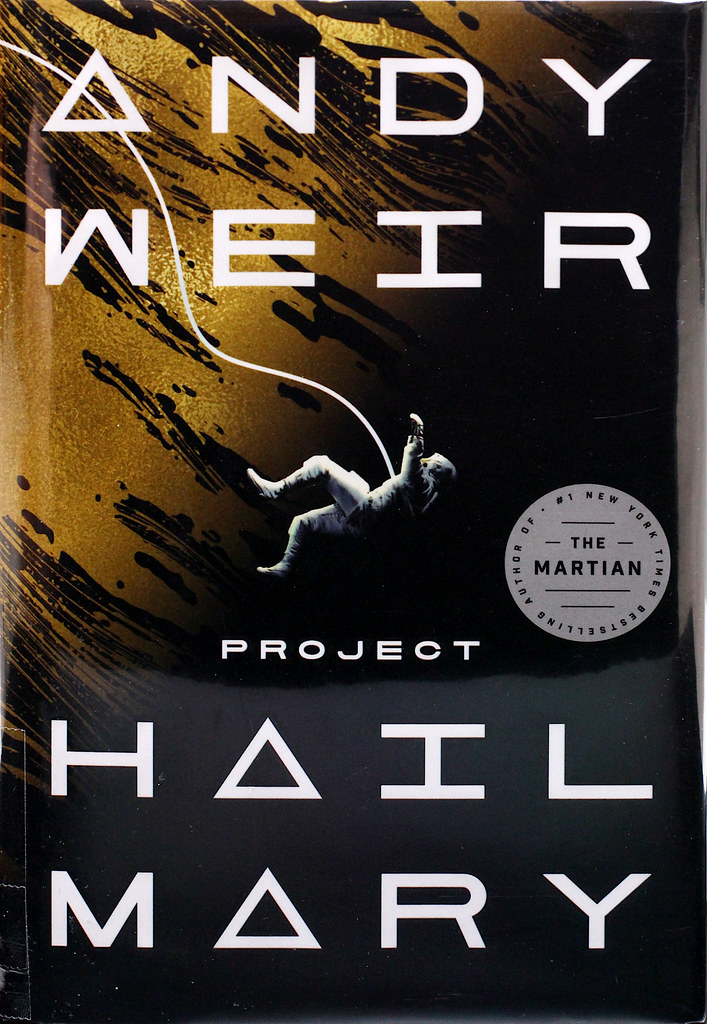
Amanda’s pick: Project Hail Mary by Andy Weir
Now that Project Hail Mary has become a huge blockbuster starring Ryan Gosling, we thought we’d republish our thoughts on the book from four years ago! Amanda is going to see Project Hail Mary this weekend, and she is so excited!
I waited six months to download Project Hail Mary, by Andy Weir, in Libby. Having read his other two novels, The Martian and Artemis, I of course was curious to discover how his newest sci-fi adventure would unfold. I don’t like spoilers, so I didn’t read reviews beforehand and dove right in with no preconceived notions. (Sort of like how we ask students not to look each other up on social media before they meet for the first time at AT…) I won’t give away the plot here, but suffice it to say that even though I thought the book came with insufficient character development and a bit too much exposition in the first few chapters, I couldn’t put it down.
So without revealing plot twists, I’ll instead share how I thought the book relates to the Adventure Treks experience. (Yes, I found a parallel between alien life and AT… sort of.) It’s quite simple: A challenge is presented that requires nothing less than teamwork, compromise, humility, and a unified stance to solve. The challenge in the book has the ability to destroy humankind—it’s quite dramatic, though the book’s urgent dilemma will probably evoke your own emotions regarding our climate crisis or politically divisive world anyway.
But to pull it back to AT, the book’s characters (including a few you really don’t see coming) must use extraordinary critical thinking and math and science skills (shout out to our STEM stars) and put the good of humankind over their personal needs in order to save not only Earth, but other worlds as well. The characters must also find common ground (which in the plot seems literally impossible at first) and build relationships based on trust—which truly becomes the driver of the plot near the end of the story. It’s really about facing adversity (one that threatens more than our small perspectives) with resilience and a team of friends standing next to you.
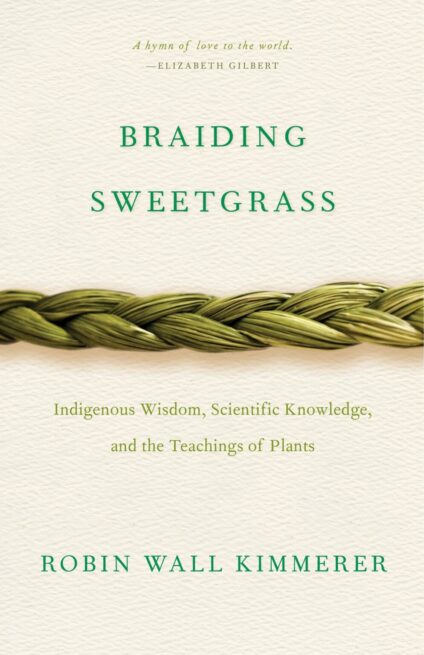
Kent’s pick: Braiding Sweetgrass by Robin Wall Kimmerer
Robin Wall Kimmerer is a botanist, educator, and member of the Citizen Potawatomi Nation. Like the actual braiding of sweetgrass, Robin weaves together the perspectives of analytical science, native traditions and ways of thinking, and stories from her personal life. She discusses the wider ecological context that includes humans as a part of nature and pushes the reader to reimagine what our relationship to the other species and processes of this Earth could be. She emphasizes the idea that nature can be our teacher just as much as books or lessons.
One of the things I found so powerful about this book is how she frames the issues of climate change, pollution, and ecological disaster through the lens of better options, things that have worked, and ways of relating to the natural world that are not exploitative. As someone who cares about the natural world, I often find myself only focusing on the negative impacts of humans on the planet and not examples of responsible land stewardship. She beautifully balances humanity’s destructive industrial past with the “social imagination” for healing and reconstruction, and this manages to be a book about climate change that leaves you feeling hopeful, which I have found rare.
Though it is science-focused, the writing style is almost more poetry than prose. It uses the author’s life experience and tribal heritage to add context and color to the science she lays out. She uses the facts about the behavior of strawberries, pecans, cattails, salamanders, maples, and sweetgrass to draw larger lessons for society as a whole. I find myself enjoying the fun facts as much as the epiphanies about human nature. Braiding Sweetgrass manages to be simultaneously highly informative and breathtakingly beautiful. I listened to this book as an audiobook, read by the author, and hearing the tone and cadence of her reading (as well as correct pronunciation of the scientific and Potowatomi words) made this a book I kept coming back to.
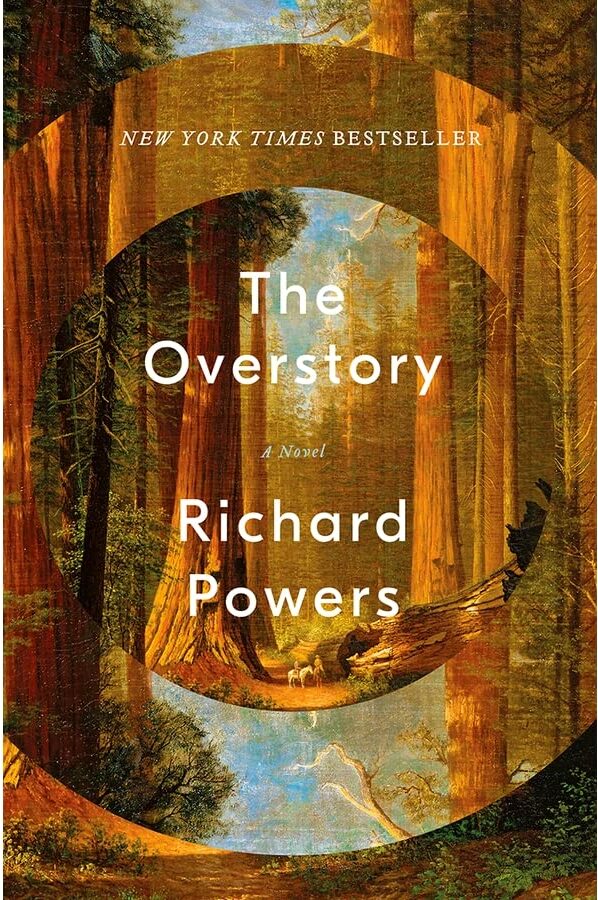
Jess’s pick: The Overstory by Richard Powers
The Overstory is an epic tome of mystical, winding stories and captivating writing. Small spoiler alert: most of these stories are sort of sad! This is a book about trees, humans, and the connections between the two—in some moments I was in awe of the magical properties of the most mundane natural cycles, and other times I found myself tearing up alongside the characters who fight for the preservation of forests.
Told through the interwoven perspectives of almost too many characters, this book navigates from sentimental to activistic with little space in between. One of the most fascinating stories is of a couple of activists who choose to live in the canopy of a redwood tree in order to protect it from being cut down. Powers shares incredible facts about these extra-tall trees. There are a variety of animals and plants (mostly mosses and fungi) that only exist high up in the redwoods and never touch the ground! (Side note, if you read this book, you should definitely hop on California Adventure or California Challenge and see one of these massive trees in person!)
Four distinct sections titled Roots, Trunk, Crown, and Seeds allow the reader to grow along with a tree’s cycle of life as the plot treads along below. When I start a book, I generally finish it within a couple of days, but with this one, I was reading for weeks! It’s dense and also beautiful, slow, and gripping. I absolutely recommend it, and I recommend that readers take their time.
We may request cookies to be set on your device. We use cookies to let us know when you visit our websites, how you interact with us, to enrich your user experience, and to customize your relationship with our website.
Click on the different category headings to find out more. You can also change some of your preferences. Note that blocking some types of cookies may impact your experience on our websites and the services we are able to offer.
Essential Website Cookies
These cookies are strictly necessary to provide you with services available through our website and to use some of its features.
Because these cookies are strictly necessary to deliver the website, refusing them will have impact how our site functions. You always can block or delete cookies by changing your browser settings and force blocking all cookies on this website. But this will always prompt you to accept/refuse cookies when revisiting our site.
We fully respect if you want to refuse cookies but to avoid asking you again and again kindly allow us to store a cookie for that. You are free to opt out any time or opt in for other cookies to get a better experience. If you refuse cookies we will remove all set cookies in our domain.
We provide you with a list of stored cookies on your computer in our domain so you can check what we stored. Due to security reasons we are not able to show or modify cookies from other domains. You can check these in your browser security settings.
Other external services
We also use different external services like Google Webfonts, Google Maps, and external Video providers. Since these providers may collect personal data like your IP address we allow you to block them here. Please be aware that this might heavily reduce the functionality and appearance of our site. Changes will take effect once you reload the page.
Google Webfont Settings:
Google Map Settings:
Google reCaptcha Settings:
Vimeo and Youtube video embeds:
Privacy Policy
You can read about our cookies and privacy settings in detail on our Privacy Policy Page.