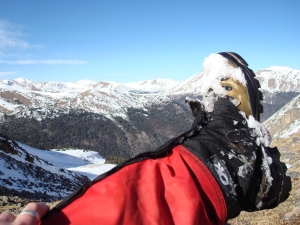
One of the most frequently asked questions we receive is about hiking boots. Because we spend so much time on our feet during trips, it’s crucial to make sure your feet are happy. Here are a few tips in picking out the right boots and breaking them in.
What is your favorite boot?
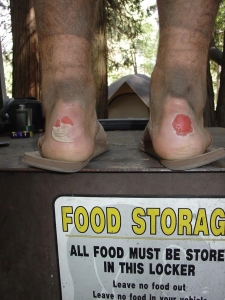
If you ask 10 Adventure Treks instructors what their favorite boot is, you’ll get 10 different answers. We all have different feet: arches, forefoot width, toe length, heel shape, and many other factors. This is why I always hesitate to tell someone to buy a certain boot. Some will fit my foot perfectly out of the box, and some will give me blisters every mile that I wear them.
Getting the correct fit
When you are shopping for a pair of boots, make sure you go to a store and try them on. Ordering online can be a little cheaper, but you don’t have access to a boot specialist from a store like REI or EMS. Bring socks that you will be wearing on the trip, as hiking socks are generally thicker than socks you wear to school or soccer practice. Make sure they fit well around your ankles and toes, meaning no pinches or painful squeezes. Feet tend to swell a little during hiking trips, so leave a little wiggle room. If they hurt walking around the store, try on another pair!
Low-cut boots or above the ankle?
Because you may not have experience in hiking with a backpack, we ask that you get a pair of above-ankle-height hiking boots. These will provide extra support as you carry weight in your pack, and you’ll be less likely to roll your ankle while hiking. Don’t try on lightweight hiking shoes; you’re looking for a mid-weight boot.
What can happen when boots don’t fit
Breaking in your boots
Your boots will be a little stiff when you first wear them. This is completely normal! The more you hike in them, the more comfortable they will get. We recommend wearing your boots around your house and neighborhood as soon as you get them. Wear them for short periods of time over a few weeks; your feet will be much happier, and you’ll be less likely to get blisters. We do not recommend cramming the break-in period into a few longer sessions right before your trip. And remember, you are breaking the boot in as much as you are getting your foot broken into the boot.
Does it need to be waterproof?
In the outdoor world, nothing is 100 percent waterproof (unless you buy rubber boots). Buying waterproof boots adds an extra expense, especially if your son or daughter is still growing (and you’ll be buying boots again). It’s not necessary to spend the extra money to get waterproof boots for Adventure Treks. However, you can apply a waterproofing product like Nikwax to add an extra layer of protection. *Do not purchase boots with open mesh covering the toes, sides, or other areas.
For the best boot-buying experience, we recommend heading to your local gear store and talking with someone in the boot department. Let them know about the Adventure Treks trip and itinerary, walk around the store in different pairs to see what fits best. Happy feet = better backpacking experience. Feel free to give us a call at 828-698-0399 with questions about boots or any other gear!
https://d52gwxhjtzjcm.cloudfront.net/2025/01/Boots-1-300x225-Bed6jc.jpg225300AT Staffhttps://www.adventuretreks.com/wp-content/uploads/2025/02/AT-logo-white-NEW.pngAT Staff2016-05-09 20:24:072025-12-28 16:41:30Boots: How to Buy and Break Them In
Congratulations to our graduating class of 2016, soon to be the class of 2020! We are always impressed—but never surprised—at the remarkable colleges Adventure Treks students will soon be attending. Below is the list of the colleges our students have chosen.
We feel privileged and grateful to have been a topic of many of your college essays. We know that navigating through the college “sorting hat” has been difficult, and we want to applaud every one of you for all the hard work you have put into your successful high school careers.
We’re so happy that our students have chosen schools that are a good fit for their personalities, abilities, and interests. We’d like to emphasize that what you will take away from your college experience has little to do with the prestige or rank of a given college, and everything to do with the mindset and attitude with which you approach your collegiate career. Success in college is about the effort poured into the experience, your desire to fuel your passions, the relationships formed with new friends and faculty, and your ability to thrive in new and sometimes ambiguous situations.
At a time when only 58 percent of students at four-year colleges graduate within six years and with more than a doubling over the past 10 years of freshman who need some kind of psychological counseling during their first year at school, we’re proud that the graduation rate of Adventure Treks students remains consistent at 98 percent! We believe the resilience, social confidence, collaboration, and community mindset skills you’ve strengthened through your Adventure Treks experiences will help you thrive in college (and the world beyond) and avoid the bumps so many students face.
Having talked to dozens of our graduates currently in college, here are some examples of how the Adventure Treks experience helped them prepare for college life:
“AT did a phenomenal job preparing me for the transition to college. I had the ability to adapt to new and changing situations. I knew how to meet friends and how to work with different kinds of people. I have seen many of my friends struggle with the transition, but it’s been easy for me.” — Christopher, University of Richmond
“AT made me more comfortable in my skin; when I got to college, I didn’t have to try to be anybody but myself. It was refreshing and empowering.” — Max, Stanford University
“At AT, you learn how to help out and look out for others, how to thrive when things aren’t easy, and how to see a bigger picture beyond yourself. AT gave me the confidence to lead a school organization my freshman year, and it means I am always the one doing more than my share in project groups.” — Jake, University of Nevada, Reno
Here’s where many of our 2016 students have landed:
1. Elena Press, Stanford University
2. Mike Schaja, Georgia Institute of Technology
3. Teresa Heise, Purdue University
4. Allie Klass, Appalachian State University
5. Laura Gaines, North Carolina State University
6. Adam Hirsch, Bates College
7. Ally Russell, Kenyon College
8. Lexi Russell, University of Richmond
9. Lucy Kates, Georgia Institute of Technology
10. Ethan Sigman, Gettysburg College
11. Griffin Gildersteen, University of Vermont or Holy Cross University
12. Jarrod Gerstein, Hamilton College
13. Justin Burman, University of Colorado, Boulder
14. Carolyn Brager, University of Washington
15. Sammy Baum, Bucknell University
16. Sarah Griffiths, Vanderbilt University
17. Jared Cloutier, Grinnell College
18. Logan Schenkel, Widener University School of Engineering
19. Timmy Michael, Stanford University
20. Hunter Simpson, University of Vermont
21. Evan Douglas, University of Wisconsin, Madison
22. Sam Lincoln, Arizona State University – Barrett Honors College
23. Benjamin Shulman, Lewis and Clark College after a gap year with NOLS
24. Anna Berger, Washington and Lee University
25. Alex Uys, Deep Springs College
26. Jeremy Uys, American University or Bowdoin College
27. Colin Finnie, Queens University
28. Hunter James, University of Alabama – Rowing Scholarship
29. Ryan Katchiss, Indiana University
30. Risa Anczelowicz, Roger Williams University
31. Josh Haley, University of Cincinnati
32. Gabriela Garrido, Hult International Business School of London
33. Andrew Burns, Sonoma State University, School of Journalism
34. Tali Abkowitz, California State College, Chico, School of Nursing
35. Lily Brice, Bucknell University
36. Pia Von Strasser, University of California -Santa Barbara
37. Aidan Birnbaum, University of Michigan
38. Morgan Keely, McGill University
39. Leah Pensler, Scripps College, UCLA, Emory University, or Wesleyan University
40. Sierra Weavil, University of North Carolina – Charlotte
41. Jarred Copley, Driver Institute of Technology: Underwater Welding
42. Mark Heiphetz, University of Idaho
43. Emma Pickard, Rhodes College
44. Olivia West, University of California, Davis
45. Sarah Crucilla, California Institute of Technology 46. Jack Lane, Tulane University 47. Mary Virginia Shook, gap year figure skating for “Disney on Ice” then University of Michigan 48. Hannah Call, College of William & Mary
2016 graduates: If we missed you, please tell us where you are heading so we can add you to this list and put you in touch with Adventure Treks students already at your new school!
Congratulations, Dock, D-Mac and the whole AT Team
When people ask me what other programs we compete with, I don’t first think of other outdoor or youth development companies—our competition is actually video games and technology.
Twenty years ago, most kids spent their summer outdoors—it was what kids did. Now programs like ours are reserved for the adventurous few as people move away from the great outdoors to the great indoors. The numbers speak for themselves; the typical teen spends nine hours daily (Common Sense Media, Kaiser Family Foundation) with digital media and less than one hour each day outdoors. So if we see our competition as technology, we have to commit to making sure that kids see us as more fun and more rewarding than video games. And if we want to compete favorably, we have to understand the appeal of technology and why it captures our kids’ imaginations.
But first… One never gets anywhere by “dissing” technology. We all know the many ways technology has enhanced our lives, and we have to constantly remind ourselves that the digital world is the only world which our kids know. Texting and Instagram are how kids socialize now. It’s not their fault; they never knew life without the internet or social media.
As parents, we have enabled this world by restricting our kids’ freedoms. Most parents, we surmise, feel more comfortable letting their kids play video games in the basement than allowing them to ride their bicycles freely around town. As the ever-watchful and highly involved parents we are, we give our kids less room to roam and less time to socialize unsupervised in public spaces than did previous generations. Because we have reduced the opportunity for the face-to-face socialization kids love, we force them online where they can create their own space with the privacy that teenagers also crave. We have to realize that technology might not necessarily be kids’ first choice of how they would like to communicate—we would argue that “face-to-face” still wins for most kids, and that technology is just the easy default.
Competing with technology and video games specifically is tough: Hundreds of millions of research dollars goes into making video games more fun each year (you can insert the word addictive if you choose), and video games have certain characteristics that make them popular.
Video games put the kids in control, and the child is at the center of the experience. While in academics, youth sports, and much of family life, it’s the adults who run things.
Video games are action packed 100 percent of the time and can be played with their friends.
Video games allow kids to create their own reality based upon their motivations—these worlds are often more vivid and exciting than their worlds at home.
Video games reward incremental success with digital prizes and/or praise. Because of this incremental success and recognition, there is constant incentive to keep playing as they continue to succeed through ever-increasing challenges.
Video games allow children to experiment and fail privately without fear of criticism. For many kids, especially boys, public failure and the associated embarrassment is the greatest fear when pushing their comfort levels.
At Adventure Treks, we build some of the same benefits of video games into our program. While we don’t have an R & D budget to match Nintendo, we have some natural advantages that make it easy for us to beat video games at their own game!
Adventure Treks is fun! We believe outdoor activities, when properly led and where fun is appropriately emphasized, can be more fun than video games! Imagine glissading (sliding) down snowy Mt. St. Helens after a spectacular summit; or mountain biking single track trails in Bend, Oregon; or rafting the mighty Nahatlatch River in British Columbia. Sorry, Call of Duty–game over!
We put kids in the center of the community. Sure, the instructors are running the show, but students have real voice in how their community runs. Students get to create their own world at Adventure Treks, and it’s usually kinder, better, and more social than the world they left at home. The instructors are young and cool enough that they can be included as part of the community in a way that parents or coaches could never be.
We are technology-free and 100 percent outdoors. The best way to beat tech is to make the place with the total absence of technology even better. We create a place where Instagram and Snapchat can’t compete with constant face-to-face interaction. When you live together 24/7 (and the norms and mores are subtly guided by “cool” mentors), the social joy of Adventure Treks makes social media pale by comparison.
Our unique 4:1 student-to-instructor ratio allows the group to break into smaller groups so challenges can be appropriate for each individual. This incremental improvement, similar to what video games offers, helps build success and confidence.
Because of our nightly evening meeting format, positive feedback is regular and abundant. We create a place where it’s safe to fail. We build a culture that encourages trying new things and pushing one’s comfort level. Kids know where they stand, and it feels good to get feedback on a regular basis.
Adventure Treks let’s kids see themselves in a new light. They get a fresh start and are not limited by their reputation from home or preconceived notions their friends may hold. With a new group of friends and away from family, they can be a different person. Meanwhile the high expectations we hold for behavior helps students become their “best selves!”
By understanding how technology fits into kids’ lives and the competition we face with digital media, it helps us keep the Adventure Treks experience relevant and ensures we don’t lose sight of the most important stuff: a tech-free connection to the outdoors and the formation of a close community led by impressive and cool role models.
This will be our 23rd summer at Adventure Treks. We simply can’t run our program the same way we did 20 years ago or even five years ago. Every year, technologies change and as kids interact with this new technology, their perception of the world changes. We have to make sure we deliver an incredible outdoor experience in a way that fits how kids raised in the digital age can receive it! And at the end of several technology-free weeks, filled with the simplicity and joy of the great outdoors, we believe teenagers’ perception of technology, might just have shifted a bit!
Not too many years from now, we predict our competition will no longer be digital media—it will probably be virtual reality—and we plan to be ready!
You don’t have to be a professional photographer to capture a fantastic shot. What’s more, you don’t even have to have a fancy or expensive camera. Today’s point and shoot cameras come equipped with systems that rival more expensive options (think digital SLRs), so you’ve got what you need to create a beautiful photograph. The next time you head out on an adventure, just keep these tips in mind and you’ll be creating magazine-worthy images before you know it.
The rule of thirds
It all begins with composition—how you set up the shot can mean the difference between a blah picture and a great photograph. Think of your camera’s screen like a grid, split up into 3 sections vertically and 3 sections horizontally (pictured; some cameras even have a menu setting that displays a grid on the screen). Avoid putting the subject, or the horizon line if shooting the ocean or clouds, in the very middle of that grid. Instead, shift it a little to the left or right, or to the top or bottom, or a combination of those. In the example pictured, the shot was composed with the tree in the upper right portion of the photo and the waterfall splitting the difference.
Perspective
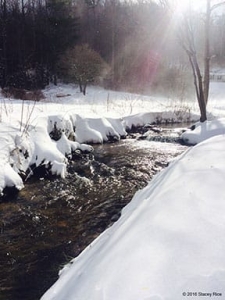
Another important concept to remember is the angle at which you’re taking the photograph. Photographing a scene straight-on can sometimes have a flattening effect, meaning it takes away the depth of field, making the subject look 2-D instead of 3-D. For instance, in the example pictured, the photo was taken from the banks of the creek, with the photographer kneeling on the ground. This way, the water travels from the top right corner to the lower left corner of the image and you can see the change in elevation between the water and the snowdrift. The image has more realistic depth (it also avoided a hypothermia-inducing walk in the frigid water—safety first!).
Drama
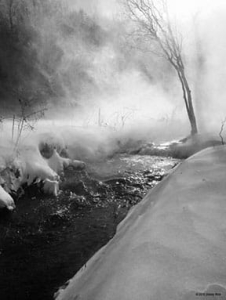
Always think about what will make the photograph look interesting and different. Below, in the image to the left, there’s a pretty contrast between the snow and the creek. But it’s just an average picture… until the wind picked up. Try to include an element of awe or surprise, and you’ll instantly add a wow factor to your photograph. Filters also help add creative elements to an image. This scene was originally shot in color, but was switched to black and white to add a more powerful contrast. Most cameras and smartphones have a variety of built-in filters. Don’t be afraid to experiment. Take the picture in the normal setting as well in case you’re not sure you’ll like the final effect.
That pesky delete button
One of the benefits of digital photography is you can take as many photographs as your memory cards will hold. It’s tempting to start deleting images out in the field, but resist the urge. Details can’t always be seen on the tiny LCD screen. You’ll be surprised at what you’ve managed to catch once the files are uploaded to the computer and you can see the image in a larger format. Spend the money on lots of gigabytes of storage. It’s worth it.
https://d52gwxhjtzjcm.cloudfront.net/2025/01/winterscene2_resize-226x300-CjYngi.jpg300226AT Staffhttps://www.adventuretreks.com/wp-content/uploads/2025/02/AT-logo-white-NEW.pngAT Staff2016-02-16 17:36:522025-12-28 16:41:30How to Take Fantastic Photos on Your Adventures
Unless you’ve spent any length of time in western North Carolina, it can be hard to imagine why so many folks—from north and south AND west—flock to this region in warmer months. Outside magazine gets it: In their recent annual Best of Travel’s “30 Best Trips of 2015,” they named North Carolina as the “Best Domestic Adventure Hub.”
Though this snippet touches on the state as a whole, they give a particular shout-out to the region in which the Adventure Treks office is located: “In the west, there’s world-class singletrack and road riding in the Blue Ridge mountains… 96 miles of Appalachian Trail, and some of the country’s best whitewater at the Nantahala Outdoor Center.”
While the Appalachians may not sound as exciting or exotic as California or Alaska, here are 5 reasons Adventure Treks loves the southern tail of the Blue Ridge mountains, why our leadership team lives here, and why the Blue Ridge Explorer trip is one of our favorites.
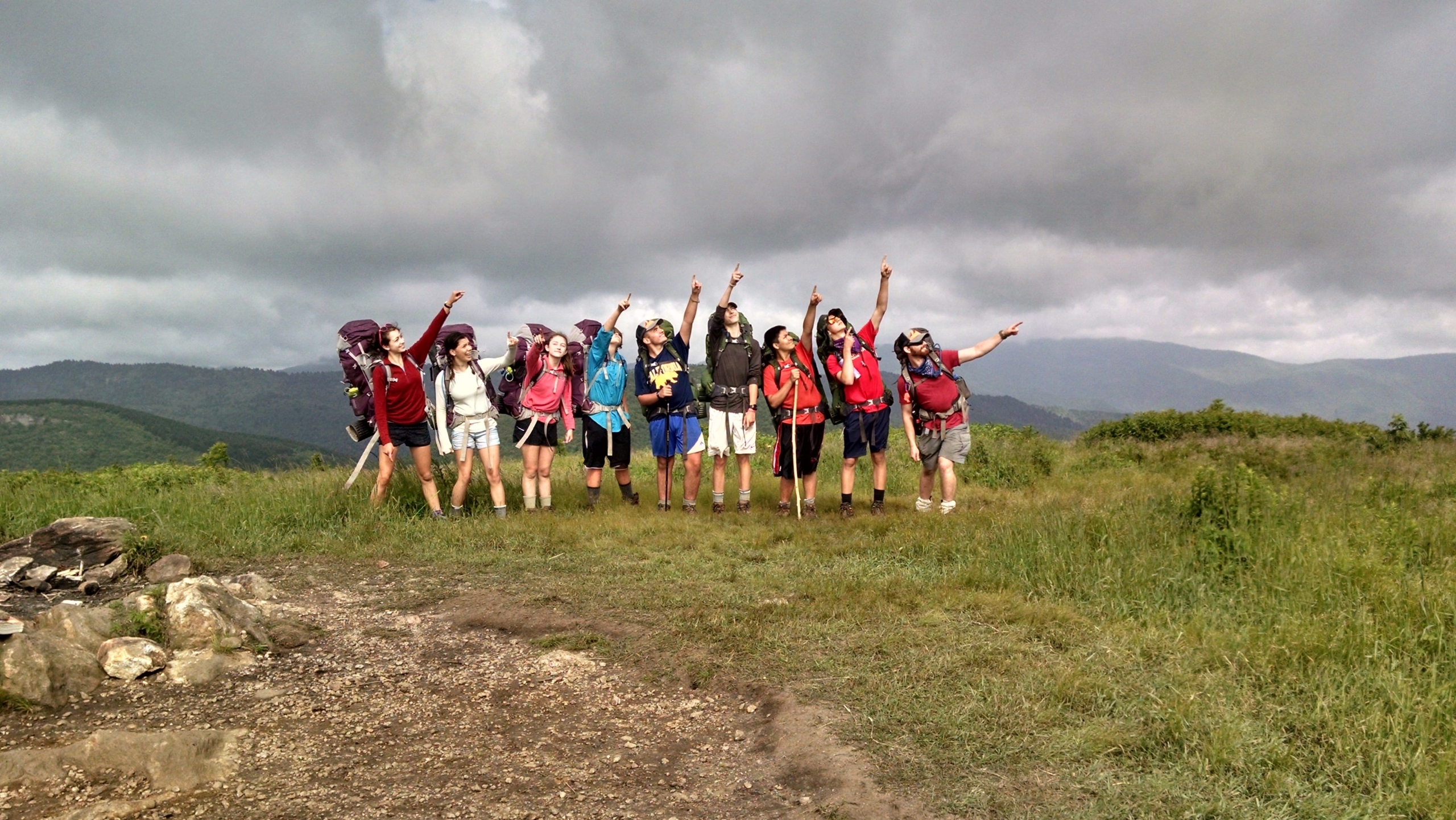
Though the highest summit in the Appalachians, Mt. Mitchell, tops out at just under 6,700 feet, during their formation more than 300 million years ago, the Blue Ridge Mountains were among the highest peaks in the world. On the Blue Ridge Explorer trip, students will get to hike in the Shining Rock Wilderness, the largest protected wilderness area in the state. They’ll traverse several peaks over 6,000 feet, including Black Balsam Knob (6,214 feet, pictured), from which they’ll be able to view several other impressive summits like Mt. Mitchell, 45 miles to the northeast, on clear days. What’s most awe-inspiring, however, is the panoramic view of the lush, vividly green rolling hills of the Black Balsam range.
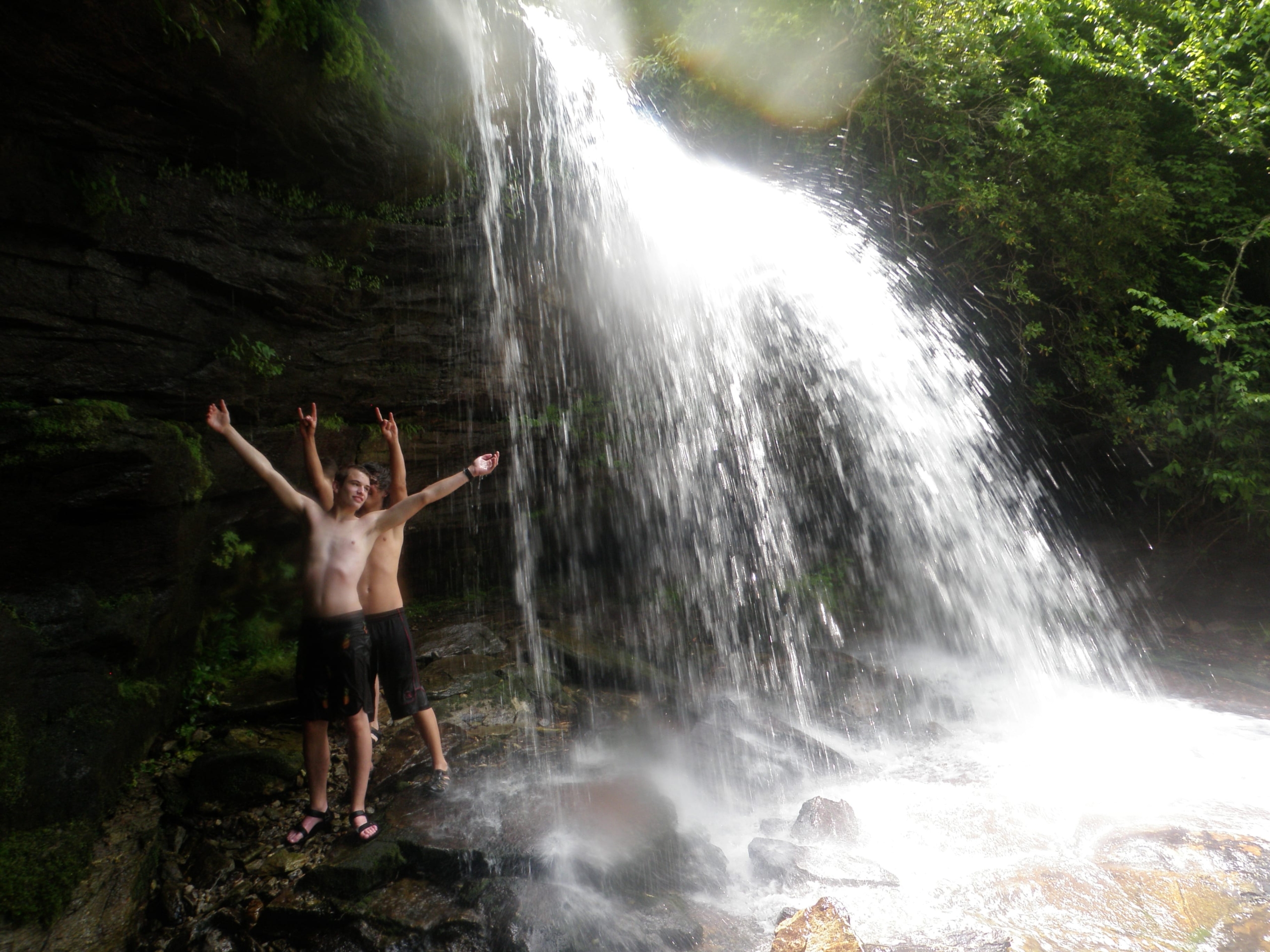
Waterfalls, waterfalls, waterfalls! There are as many as 1,500 waterfalls in North Carolina, and the other area in which we backpack, Panthertown Valley, houses at least eight of the prettiest ones. Students will have the chance to stop and swim around beneath the larger falls, including Schoolhouse Falls (pictured). There’s no better way to cool off on a hot day than having “splash wars” in crystal-clear swimming holes next to sandy beaches! Panthertown, a 6,700-acre tract of gorgeous wilderness, also contains huge granite domes, validating its nickname “Yosemite of the East.”
More water! Just as impressive as our host of waterfalls is the sheer volume of rivers running through western North Carolina. Known as a hotbed for boating enthusiasts, our students spend five to six days inflatable kayaking, canoeing, and whitewater rafting the great waterways of the region. The Chattooga River, the first river east of the Mississippi to be designated a Wild and Scenic River, has some of the most exciting rapids we paddle. They’ll also hop into inflatable kayaks, aka “duckies,” down the Nantahala River, culminating with the optional drop down the dramatic, class 3 Nantahala Falls. Finally, Blue Ridge students will learn and hone canoeing skills on either the serene Lake Santeetlah (pictured) or the French Broad River, which is the third-oldest river in the world!
Chances are your teenager has seen the movie The Hunger Games, and it’s also likely that your teenagers knows that filming took place all over western North Carolina. On the Blue Ridge Explorer, our students mountain bike through DuPont State Forest, where some of the more memorable movie scenes take place at Triple Falls (pictured) and Bridal Veil Falls. DuPont’s single-track trails attract mountain bikers of all skill levels, and many of its trails offer something that most Appalachian forests don’t: slickrock, i.e. smooth, wind-polish rock trails, that wind through beautiful waterfalls and rare habitats like high-elevation bogs.
Last but not least, the wildly diverse ecological systems of North Carolina help make the Blue Ridge Explorer trip so memorable. Students will have a birds-eye view as they zipline through the Green River Gorge, whizzing through deciduous forests down 1,100 vertical feet. This gorge has some of the most dramatic landscapes of any area we visit in North Carolina, and is bursting with plant and animal life as one of the most bio-diverse regions in the eastern United States. This zipline is one of the fastest in the United States—the perfect end to a wonderfully fun trip.
https://d52gwxhjtzjcm.cloudfront.net/2025/01/BRA1-2015-244-300x169-gYncys.jpg169300AT Staffhttps://www.adventuretreks.com/wp-content/uploads/2025/02/AT-logo-white-NEW.pngAT Staff2016-02-09 13:15:282025-12-28 16:41:30Why AT Loves the Blue Ridge Mountains—And Why Our Students Do, Too
We’d like to share an observation that we have made over the years, a phenomenon that often happens to students between their first and second summer of Adventure Treks:
After the first adventure ends, a student enthusiastically registers for next summer and a brand-new adventure destination. They are excited to come back to see their friends, their instructors, improve outdoor skills, and see new places. That student might have had a few challenging days of adjustment to outdoor life at the start of the trip, but ended up proud of everything they had accomplished, thrilled to be part of a close community experience, and even “camp sick” when it was time to return home.
Several months later, the same student comes to their parents and says, “I’m not sure about returning to Adventure Treks.” The parents are confused; what has changed?
Sometimes, those parents shrug their shoulders and consider cancelling the trip. They don’t want to “force” their child to return.
Number 3 is a loving and understandable reaction, but we want to suggest an alternative.
Before we do so, let us describe what is actually happening. This is what we call the “warrior/worrier” story. In short, we believe that everyone has a warrior who lives on one shoulder, and a worrier on the other. The warrior wants to embrace opportunities, try new things, and go on adventures. The worrier, on the other hand, wants to avoid anything uncomfortable and fears the potential for public failure. We suggest students listen to their warrior, and not the worrier.
The student who wants to return is listening to the warrior, thinking about new friendships, new outdoor adventures, and the caring and cool instructors. But as the year goes on, the worrier starts to whisper: “Remember those days without a shower?” or “That one hike that was really hard.” Or “do you really want to sleep in a tent instead of your bed?” Sometimes, the worrier changes the memory of the Adventure Treks experience, and suddenly, the confident and excited student begins to believe that they were homesick most of the time, and the struggle from that hard hike or challenging activity starts to loom larger than the successes and resilience achieved from overcoming obstacles.
At this moment, parents have an interesting choice. The easy one is to simply say, “I do not want to force my child to return.” Another—what we suggest—is more nuanced: “I want to feed my child’s warrior and weaken the worrier.”
This does not mean ignoring your child’s concerns, but it does mean helping redirect thoughts to the fun, friends, and growth at Adventure Treks. Ask your child about what they loved at AT. If you know who their favorite friends and instructors were, ask about them. Look at the photos or 2015 summer memories video.
Here are some good questions:
What was your favorite memory of AT?
Tell me about ________ [a great AT friend] again.
What was your favorite activity?
Tell me about a favorite instructor?
How is what you learned last summer helping you out at school and home?
We also encourage you to call us and ask any questions if you have any lingering concerns or want advice. If you do think that your child encountered an issue that is concerning, we want to partner with you to turn this concern into an opportunity for both of us.
We hope this blog helps prepare you for an event that is not rare, and can be initially alarming. Hopefully your student won’t have any second thoughts about the summer of 2016. As always, we strive to be partners in the parenting process.
https://d52gwxhjtzjcm.cloudfront.net/2025/01/ice-climbers.jpg633844AT Staffhttps://www.adventuretreks.com/wp-content/uploads/2025/02/AT-logo-white-NEW.pngAT Staff2016-01-17 15:06:182025-12-28 16:41:30Second Thoughts Can Be Natural
Our instructors say thank you to our parents for sharing absolutely wonderful students with us! We miss them!
Although summer is behind us, Adventure Treks is still going strong, with 24 of our summer instructors here in North Carolina. Two different schools join us each week in Pisgah National Forest or at our very own Camp Pinnacle for outdoor education and community building programs. This fall, we will work with more than 750 students and schools will travel from as far away as Florida, Ohio, Tennessee, and Georgia to join Adventure Treks.
https://www.adventuretreks.com/wp-content/uploads/2025/02/AT-logo-white-NEW.png00AT Staffhttps://www.adventuretreks.com/wp-content/uploads/2025/02/AT-logo-white-NEW.pngAT Staff2015-09-12 12:21:322025-12-28 16:41:37Adventure Treks Thank You Video
The boarding announcement interrupted a nice conversation in Portland. Our last student of 2015, Gaetan, quickly hopped on his Delta plane to Paris and just like that… the summer was over… and so was the magic of Adventure Treks. This summer ended as strongly as I can remember. The students formed close and inclusive communities, and we aren’t quite ready for it all to end.
Our staff teams have returned to our Portland area base camp—landing from adventures in Alaska, California, Colorado and British Columbia. We admit it—we are tired! But it’s the good kind of tired; we are exhausted from giving it our all over an extended period. But the hard work has paid off. We are ecstatic about what has been accomplished and what a safe, successful and growth-filled summer it’s been for all of us. We hope our students now consider Adventure Treks a “second home,” a happy and joyful place where they could be themselves and escape from some of the pressures of being a teenager. We believe our students have seen their best selves and are excited about the young adults they are becoming!
We would like to compliment and thank you as parents. It takes a lot of courage to send your child across the country into the great unknown and to trust leaders whom you’ve never met. We greatly appreciate your trust and hope that the benefits your child has received by stepping out of their comfort zone this summer has made choosing Adventure Treks one of your better parenting decisions. We hope to continue to be your partner in assisting you as your raise great kids and we appreciate your support.
We hope the power of living outdoors, free from technology, surrounded by incredible scenery and impressive role models in a shared community has been slightly life-altering. Our students have experienced the give and take of living in a community and have seen that they can accomplish more than they thought possible, especially with the help of their friends. We hope your kids have come home happy, more independent, confident, and full of great stories. They definitely have laughed a lot and stood in awe of incredible scenery. They have thrived without electronics, and, in most cases, had so much fun they barely missed their smartphones! I hope it will take a long, long time for the smiles to wear off their faces and that their new confidence never fades.
Our instructors have done very strong work, and I’m extremely proud of their commitment, rapport with teens, hard work, and dedication. I’d also like to give a shout out to the folks behind the scenes who have made this summer run so smoothly. Our directors have worked tirelessly solving small logistical snafus before they became problems. They’ve driven delayed bags hundreds of miles to campsites, they have filled in for instructors who have had family emergencies, and they’ve burned thousands of airline miles helping to open and close every trip. They’ve delivered extra food and special treats; they have set up rock climbing sites at 4 in the morning; and they’ve done whatever it takes to set our students up to have incredible summers. I’m also proud of our office staff. They have checked and rechecked every flight, posted trip blog after trip, and reassured a nervous parent or two. I’m grateful for all they have contributed this summer and indebted for our team’s commitment to Adventure Treks.
It’s been a privilege getting to know your children this summer. We’ve tried to treat your kids as our own, and we believe we have had an impact. While there are still things we can improve and we will work hard do that for 2016, I’m very pleased with the summer—we gave it our best.
Though we are eager for a rest, there is a lot more still to do! We begin instructor orientation on August 24 for our second season, consisting of outdoor education and science programs for schools. Over the next 10 weeks, we will keep 24 of our instructors on staff as we work with 15 different schools from eight different states, giving almost 800 students a small dose of Adventure Treks.
We sure are going to miss our great students. Thank you for being part of Adventure Treks 2015.
https://d52gwxhjtzjcm.cloudfront.net/2025/01/sunrise-300x225-ZKQLqO.jpg225300AT Staffhttps://www.adventuretreks.com/wp-content/uploads/2025/02/AT-logo-white-NEW.pngAT Staff2015-08-13 20:14:402025-12-28 16:41:37Thank you for a Great 2015 Summer!
Greetings from 30,000 feet! Our four regional directors are currently flying all over the country visiting our Adventure Treks trips. More than 130 students have already completed their Adventure Treks summer experiences, and we couldn’t be more pleased with the wonderful, kind, and capable students who we have met so far this summer. We feel they have taken much away from the experience, including beautiful scenery, close communities, great relationships with their instructors, new confidence earned as a result of great accomplishment, and wonderful new friendships! We have 112 students currently in the field, and we are eager to meet the 154 students who will soon be arriving.
We thought we would share the musings of one of our parents, Dara Redler, from Atlanta, whose three children have participated in seven Adventure Treks summers. Her thoughts on technology and the Adventure Treks experience capture the essence of the joy of being technology-free at Adventure Treks for three weeks.
My son, Mason, called me from the Seattle airport to say he had arrived safely for his British Columbia Adventure and was excited. He couldn’t talk long as he had to meet the group and turn in his phone. For the next three weeks he would be hiking and camping in British Columbia with Adventure Treks, and there is a no-electronics policy, including no phone. For some parents, the thought of no call, text, tweet, post, picture or chat from their child for three weeks might seem unnerving. When my son hung up, I felt this wave of happiness.
My son is like any other teenager where that phone has become a constant appendage to his body; his head is constantly lowered looking at a screen, and his fingers type and swipe faster than a piano player. It’s not that I won’t miss the communication, but I know what “turning in his phone” is about to provide for him.
Images of the incredible landscapes will not be seen through a screen, but rather will be viewed with eyes wide open and stored in his mind forever. He will “chat” not through typed words, but will have real conversations with friends as he hikes with them side by side for hours. I smile thinking about them laughing at each other’s skits and silliness rather than laughing at videos someone else created. They will learn how to make each other laugh, and appreciate the humor each possesses.
What the students “like” will be actually shared face-to-face rather than acknowledged with a click. Their every move will not be posted or tweeted, but will be enjoyed by those experiencing it together. Games are played with each other. The only music is what they sing together. To “friend” someone is not a mere electronic gesture, but rather a sharing of special times and helping each other through these weeks. There will be no images captured of food served to them as they learn to cook for themselves and take pride in what they created. And instead of a last text saying B4N (“bye for now”), they will actually say goodnight as they fall asleep together under the stars.
As excited as I was for him, I know he was just as excited to turn in that phone and start his journey. He knows he gets to spend the next three weeks experiencing real connections with friends in incredible scenery. All of the noise about what “friends” back home did, saw, heard, ate or thought that day will not be missed at all. That appendage will return soon enough, but for now I am giddy knowing the phone is turned off and in a Ziploc bag for some time later.
We are thrilled to give our students a chance to disconnect from technology and reconnect with nature and form social connections that will be stronger and more beneficial than their digital connections.
We are sad to say goodbye to our first students, and we hope the time without technology has been restorative. Having had the time of their lives without technology, we hope as they return to civilization, our students better understand that technology is a tool they can control and turn on and off as they want to. Rather than letting technology or social media dominate their social relationships and recreation, we hope the time spent at Adventure Treks puts technology in perspective. The great thing is that outdoor activities are one of the few things that can actually be more fun than digital technology.
As parents, we are the ultimate role models for our kids, so it’s always important to examine our own relationship with technology. Here are a few statistics from our friends at the Digital Detox Center that you might find interesting. Some, we must admit, hit a little too close to home!
The average American dedicates 30% of leisure time to perusing the web.
50% of people prefer to communicate digitally than in person.
67% of cellphone owners find themselves checking their device even when it’s not ringing or vibrating.
One out of 10 Americans report depression; heavy internet users are 2.5 times more likely to be depressed than lighter internet users.
The average employee checks 40 websites a day, switching activities 37 times an hour, changing tasks every two minutes.
The average employee spends two hours a day recovering from distractions.
60% of people say traditional vacation does not relieve their stress.
33% of people admit to hiding from family and friends to check social media.
https://d52gwxhjtzjcm.cloudfront.net/2025/01/tree-big-one-300x300-ZwBTRv.jpg300300AT Staffhttps://www.adventuretreks.com/wp-content/uploads/2025/02/AT-logo-white-NEW.pngAT Staff2015-07-15 00:46:232025-12-28 16:41:37Disconnecting in Order to Connect – A Parent’s Perspective
Every year, Adventure Treks kicks off the summer with our five-day Trip Leader Retreat in Oregon, where our leadership team gathers in a cabin near Mt. Hood, next to the Salmon River, for senior staff training.
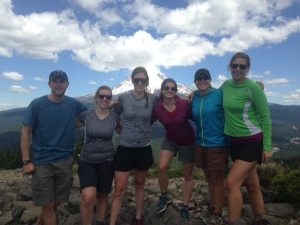
Our 14 trip leaders and four regional directors hail from 11 states, average 29.5 years old, and have 129 collective years of Adventure Treks experience, with an average of 7.3 seasons of AT experience each. (Two were former Adventure Treks students!) I’m proud to be a part of this group of mentors who will be training our new instructors and overseeing the success of our trips. As an Adventure Treks parent myself, I’m also thrilled to have these role models interacting with and inspiring my own kids!
The other half of our awesome trip leader team.
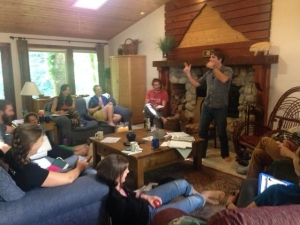
So what do we do at Trip Leader Retreat? Besides forming our leadership team community, we apply leadership theory and current child psychology and brain theory to Adventure Treks. We also learn and relearn the specific details of each trip itinerary, and we use this time to review safety and the policies and procedures that lead to successful trips. Together, we share the tips and tricks we’ve gleaned as we work hard to make every trip exceptional.
DMAC loves talking to our trip leaders!
As we prepared for our all-staff orientation that began June 9, I wanted to share what we have been reading this winter. It’s our job to stay on top of the latest youth development trends and literature so we can make sure that the Adventure Treks program remains relevant to parents. Besides being a ridiculous amount of FUN, as your partners, we want Adventure Treks to be a tool that helps kids develop the skills, mindset, optimism, confidence, character, and resilience that will help them become happier and more capable adults.
Topics from these and other books will be featured in our instructor orientation sessions as we facilitate the best possible learning and growing experience for your child. Below are our 2015 suggestions for those who share our obsession in helping teenagers experience personal growth.
From Harvard’s Robert Putnam, the expert on community who wrote the seminal book, Bowling Alone, we have a treasure trove of data on how kids succeed among the tremendous inequality brewing in our country. One of his many conclusions is that it matters deeply who your kids go to school (and camp) with. He also stresses that non-cognitive skills (communication, collaboration, creativity, grit and resilience—the things we teach and practice at Adventure Treks) are very often the key to adult success.
Two generations ago, the vast majority of “our kids” went on to live lives better than those of their parents and society generally aided them. But their children and grandchildren (the current generation) have had less opportunity amid diminishing prospects and less help from the “bigger community.” Putnam tells the tale of lessening opportunity through poignant life stories of rich and poor kids from cities and suburbs across the country, drawing on a formidable body of research done specifically for this book.
Responding to what he calls the culture of the “Big Me” (which emphasizes external success), David Brooks challenges us, and himself, to re-balance the scales
between our “résumé virtues”—achieving wealth, fame,
and status—and our “eulogy virtues”— those that exist
at the core of our being: kindness, bravery, honesty, or faithfulness—focusing on what kind of relationships we have formed. (Read more about how we focus on character development at Adventure Treks in this blog.)
Looking to some of the world’s greatest thinkers and inspiring leaders, Brooks explores how, through internal struggle and an understanding and appreciation of one’s own limitations, people have built a strong inner character.
The author who brought us Mean Girls and Queen Bees and Wanna Bees, Rosalind Wiseman has now written the definitive book on boys: Masterminds and Wingmen. Using a panel of more than 160 boys (including at least one Adventure Treks alum), Wiseman exposes us to the world of teenage boys and gives us great insight into the lives our boys are experiencing, the rules of boys’ world, and how male teenage power structures work. She introduces the “Act like a Man Box” and the effects attempting to live up to these expectations can have on young male behavior. As school and the economy change, we are concerned that boys are falling behind, and we hope the culture we create at Adventure Treks will help our male students succeed in life outside camp.
Below are books we still use frequently and have included on previous lists.
In Mindset, Stanford researcher Carol Dweck explains why it’s not just our abilities and talent that bring us success, but whether we approach challenges with a fixed or a growth mindset. Praising intelligence and ability isn’t the best way to foster self-efficacy and confidence, and may instead actually jeopardize success. Instead, understanding that the brain is malleable, and that we are all works in progress, leads to the development of a growth mindset. By encouraging and rewarding effort and hard work over innate talent, we can better motivate our kids to more eagerly approach new challenges while building resilience. We use Dweck’s book in instructor orientation to show staff how to encourage our students to develop a mindset focused on continuous growth rather than accepting our talents and abilities as fixed.
Harvard professor Edward Hallowell gives us a
wonderful five-step program to help give our kids a childhood that creates a footprint for them to
become happy adults. In The Childhood Roots of Adult Happiness, Hallowell promotes childhood as a time to provide opportunities to feel connected to others, to play and be joyful, to practice and attain mastery in numerous activities, to fail and build resilience, and to receive recognition.
We use Hallowell’s model in our staff training and
wrote a blog about how his model applies to Adventure Treks.
One of the Wall Street Journal’s “most important reads for 2013,”The Big Disconnect: Protecting Child and Family Relationships in the Digital Age discusses how technology is affecting family relationships and how parents’ involvement with technology at home affects family connections. Renowned clinical psychologist and author Catherine Steiner-Adair explains that families are now in crisis around this issue. Not only do chronic technology distractions have deep and lasting effects, but children desperately need warm interactions with the adults in their lives.
Drawing on real-life stories from her clinical and consulting work, Steiner-Adair offers insights and advice on how parents can achieve greater understanding and confidence as they come up against the tech revolution happening in their living rooms. When Adventure Treks students have an amazing experience and succeed beyond all expectations without any technology, they are often given a unique perspective on how technology fits into their lives. Read a recent blogwe wrote about her book.
We may request cookies to be set on your device. We use cookies to let us know when you visit our websites, how you interact with us, to enrich your user experience, and to customize your relationship with our website.
Click on the different category headings to find out more. You can also change some of your preferences. Note that blocking some types of cookies may impact your experience on our websites and the services we are able to offer.
Essential Website Cookies
These cookies are strictly necessary to provide you with services available through our website and to use some of its features.
Because these cookies are strictly necessary to deliver the website, refusing them will have impact how our site functions. You always can block or delete cookies by changing your browser settings and force blocking all cookies on this website. But this will always prompt you to accept/refuse cookies when revisiting our site.
We fully respect if you want to refuse cookies but to avoid asking you again and again kindly allow us to store a cookie for that. You are free to opt out any time or opt in for other cookies to get a better experience. If you refuse cookies we will remove all set cookies in our domain.
We provide you with a list of stored cookies on your computer in our domain so you can check what we stored. Due to security reasons we are not able to show or modify cookies from other domains. You can check these in your browser security settings.
Other external services
We also use different external services like Google Webfonts, Google Maps, and external Video providers. Since these providers may collect personal data like your IP address we allow you to block them here. Please be aware that this might heavily reduce the functionality and appearance of our site. Changes will take effect once you reload the page.
Google Webfont Settings:
Google Map Settings:
Google reCaptcha Settings:
Vimeo and Youtube video embeds:
Privacy Policy
You can read about our cookies and privacy settings in detail on our Privacy Policy Page.

 You don’t have to be a professional photographer to capture a fantastic shot. What’s more, you don’t even have to have a fancy or expensive camera. Today’s point and shoot cameras come equipped with systems that rival more expensive options (think digital SLRs), so you’ve got what you need to create a beautiful photograph. The next time you head out on an adventure, just keep these tips in mind and you’ll be creating magazine-worthy images before you know it.
 Perspective
 Always think about what will make the photograph look interesting and different. Below, in the image to the left, there’s a pretty contrast between the snow and the creek. But it’s just an average picture… until the wind picked up. Try to include an element of awe or surprise, and you’ll instantly add a wow factor to your photograph. Filters also help add creative elements to an image. This scene was originally shot in color, but was switched to black and white to add a more powerful contrast. Most cameras and smartphones have a variety of built-in filters. Don’t be afraid to experiment. Take the picture in the normal setting as well in case you’re not sure you’ll like the final effect.
 Though the highest summit in the Appalachians, Mt. Mitchell, tops out at just under 6,700 feet, during their formation more than 300 million years ago, the Blue Ridge Mountains were among the highest peaks in the world. On the Blue Ridge Explorer trip, students will get to hike in the Shining Rock Wilderness, the largest protected wilderness area in the state. They’ll traverse several peaks over 6,000 feet, including Black Balsam Knob (6,214 feet, pictured), from which they’ll be able to view several other impressive summits like Mt. Mitchell, 45 miles to the northeast, on clear days. What’s most awe-inspiring, however, is the panoramic view of the lush, vividly green rolling hills of the Black Balsam range.
 Waterfalls, waterfalls, waterfalls! There are as many as 1,500 waterfalls in North Carolina, and the other area in which we backpack, Panthertown Valley, houses at least eight of the prettiest ones. Students will have the chance to stop and swim around beneath the larger falls, including Schoolhouse Falls (pictured). There’s no better way to cool off on a hot day than having “splash wars” in crystal-clear swimming holes next to sandy beaches! Panthertown, a 6,700-acre tract of gorgeous wilderness, also contains huge granite domes, validating its nickname “Yosemite of the East.”
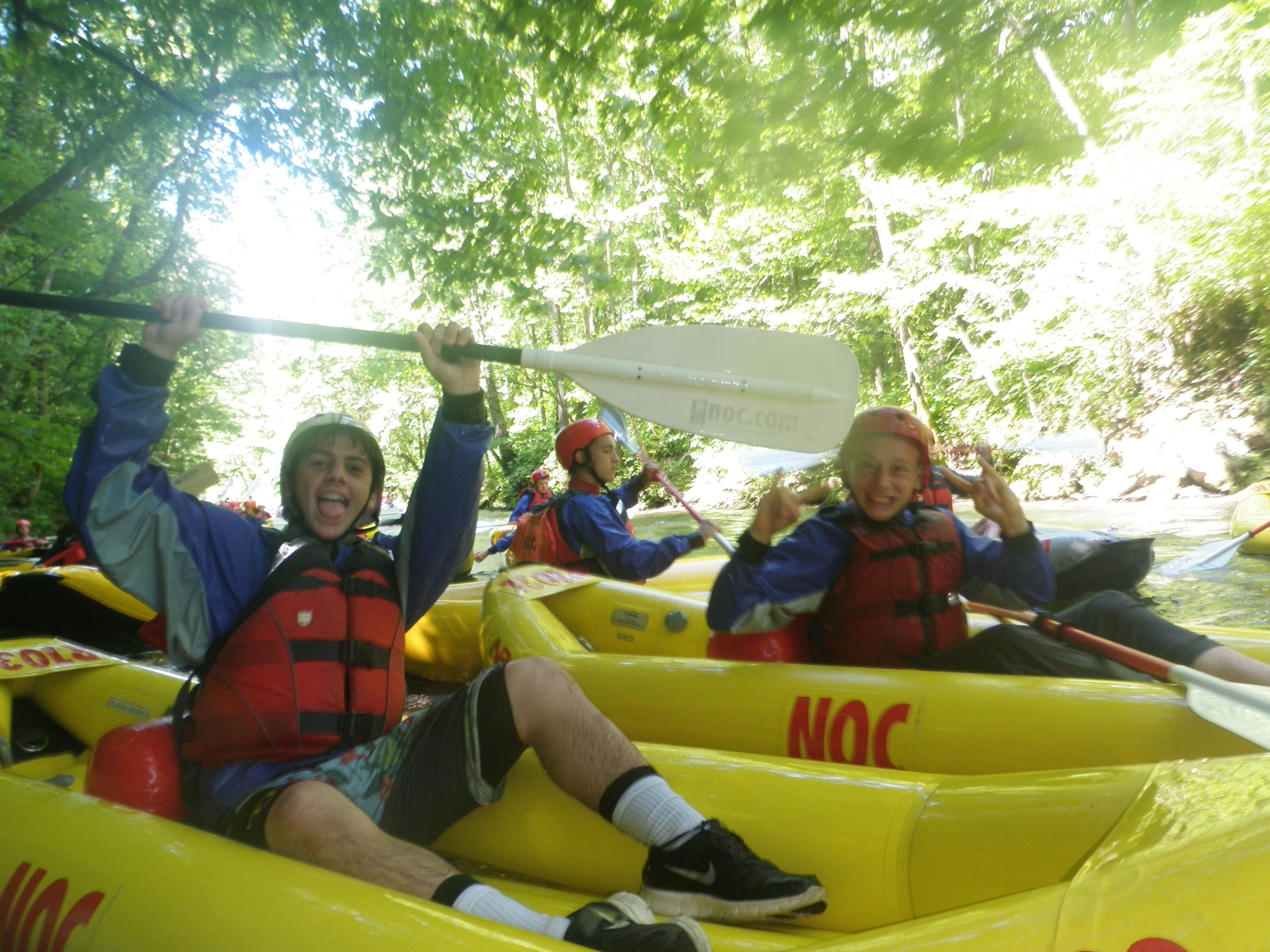 More water! Just as impressive as our host of waterfalls is the sheer volume of rivers running through western North Carolina. Known as a hotbed for boating enthusiasts, our students spend five to six days inflatable kayaking, canoeing, and whitewater rafting the great waterways of the region. The Chattooga River, the first river east of the Mississippi to be designated a Wild and Scenic River, has some of the most exciting rapids we paddle. They’ll also hop into inflatable kayaks, aka “duckies,” down the Nantahala River, culminating with the optional drop down the dramatic, class 3 Nantahala Falls. Finally, Blue Ridge students will learn and hone canoeing skills on either the serene Lake Santeetlah (pictured) or the French Broad River, which is the third-oldest river in the world!
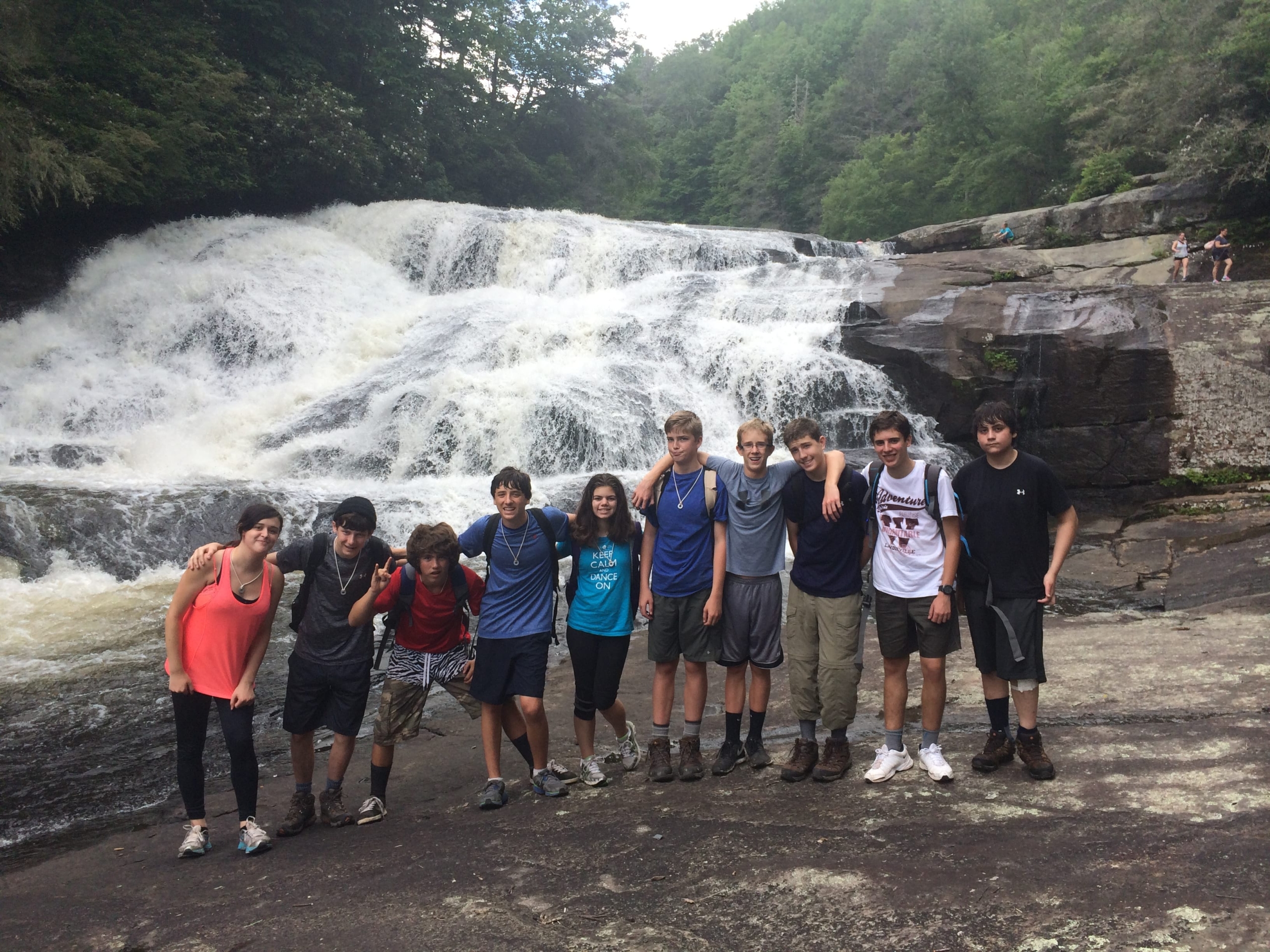 Chances are your teenager has seen the movie The Hunger Games, and it’s also likely that your teenagers knows that filming took place all over western North Carolina. On the Blue Ridge Explorer, our students mountain bike through DuPont State Forest, where some of the more memorable movie scenes take place at Triple Falls (pictured) and Bridal Veil Falls. DuPont’s single-track trails attract mountain bikers of all skill levels, and many of its trails offer something that most Appalachian forests don’t: slickrock, i.e. smooth, wind-polish rock trails, that wind through beautiful waterfalls and rare habitats like high-elevation bogs.
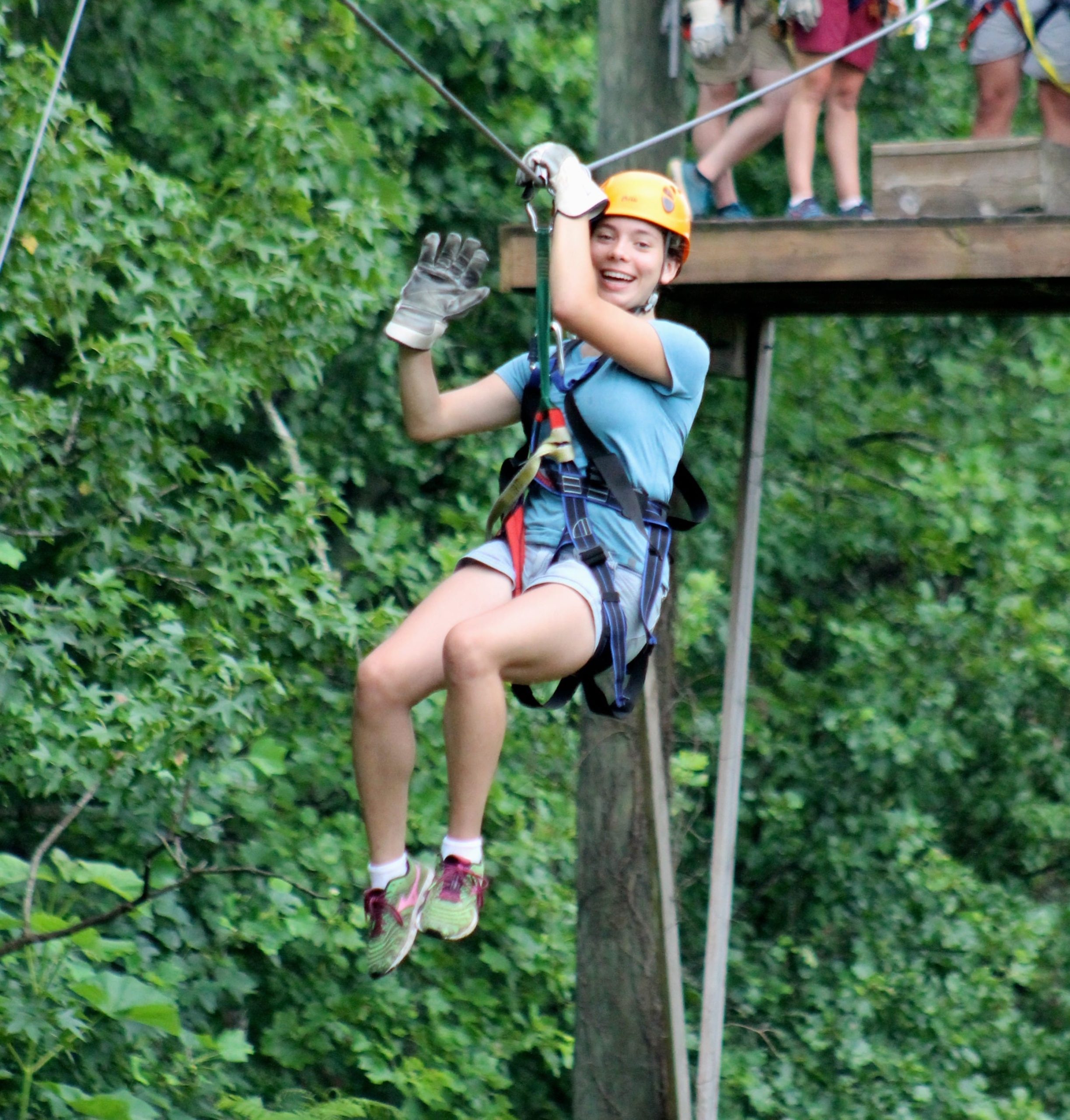 Last but not least, the wildly diverse ecological systems of North Carolina help make the Blue Ridge Explorer trip so memorable. Students will have a birds-eye view as they zipline through the Green River Gorge, whizzing through deciduous forests down 1,100 vertical feet. This gorge has some of the most dramatic landscapes of any area we visit in North Carolina, and is bursting with plant and animal life as one of the most bio-diverse regions in the eastern United States. This zipline is one of the fastest in the United States—the perfect end to a wonderfully fun trip.



 In Mindset, Stanford researcher Carol Dweck explains why it’s not just our abilities and talent that bring us success, but whether we approach challenges with a fixed or a growth mindset. Praising intelligence and ability isn’t the best way to foster self-efficacy and confidence, and may instead actually jeopardize success. Instead, understanding that the brain is malleable, and that we are all works in progress, leads to the development of a growth mindset. By encouraging and rewarding effort and hard work over innate talent, we can better motivate our kids to more eagerly approach new challenges while building resilience. We use Dweck’s book in instructor orientation to show staff how to encourage our students to develop a mindset focused on continuous growth rather than accepting our talents and abilities as fixed.
 Harvard professor Edward Hallowell gives us a
 One of the Wall Street Journal’s “most important reads for 2013,” The Big Disconnect: Protecting Child and Family Relationships in the Digital Age discusses how technology is affecting family relationships and how parents’ involvement with technology at home affects family connections. Renowned clinical psychologist and author Catherine Steiner-Adair explains that families are now in crisis around this issue. Not only do chronic technology distractions have deep and lasting effects, but children desperately need warm interactions with the adults in their lives.