While we’re confident you’ve been packed and ready for your adventure for weeks (wink, wink), here are a couple videos and some friendly reminders to help simplify the process:
How to pack for your adventure:
Your Daypack (a school bookbag is perfect)
ID/passport
Put your cell phone, medications, iPod, wallet, passport, and return ticket in a ziplock bag with your name on it. You will give this to your instructors at the airport.
Pack your essentials in case your bags are delayed. This includes a toothbrush, jacket, raincoat, empty water bottle, and anything else you might need if your bags are late.
Your Checked Bag (a soft-sided duffel bag is highly recommended)
Fit everything on your trip’s packing list into your duffel bag. Some airlines charge extra for one or more checked bags – please be ready.
This should be a duffel bag WITHOUT wheels. Wheels can damage other bags, and occasionally our instructors.
Check with your airline for size and weight limits on checked bags
https://www.adventuretreks.com/wp-content/uploads/2025/02/AT-logo-white-NEW.png00AT Staffhttps://www.adventuretreks.com/wp-content/uploads/2025/02/AT-logo-white-NEW.pngAT Staff2013-06-03 20:25:542025-12-28 16:41:51How to Pack for Your Adventure Treks Trip
Adventure Treks students consistently say that a highlight of Adventure Treks is making great friendships with students and instructors from across the country and around the world. Knowing people’s world views are partially shaped by the communities in which we live, making friends with people who have had different life experiences is a wonderful opportunity. It’s also nice to discover that when we share a unified vision for our trip, it’s easy to all work together towards a common goal and together create a community that fosters a culture of kindness, inclusion and respect.
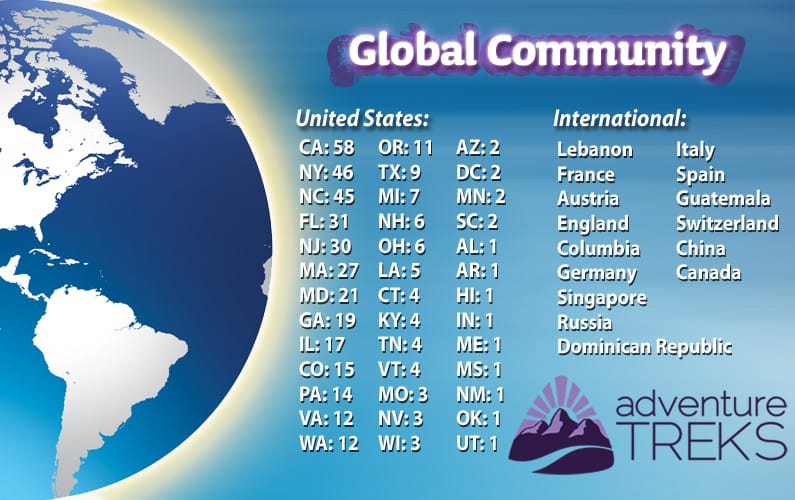
This year, we will welcome students from 39 different states and 15 countries. We are still waiting to get a student from North Dakota. If you know anybody in Bismark or Fargo, please send them our way! The graphic above shows where our students and instructors will be coming from. This map will expand a little as we fill our last spaces for the summer over the next few weeks.
Please get any remaining paperwork in to our office as our truck rolls across the country in early June. Remember to get in your best possible shape and break in those new boots! The first Plus-Delta of the summer will be at trip leader retreat near Mt. Hood, OR on June 5!
We can’t wait to see you on your opening day. Good luck with your final exams.
https://d52gwxhjtzjcm.cloudfront.net/2025/01/green-mountains-1.jpg12001600AT Staffhttps://www.adventuretreks.com/wp-content/uploads/2025/02/AT-logo-white-NEW.pngAT Staff2013-05-23 15:42:312025-12-28 16:41:51Forming a Community from Around the World.
You can feel the excitement at the AT office build as the countdown to summer accelerates. We can’t wait to meet our students for whom we all come together each summer. Boxes of brand new outdoor gear arrive in our warehouse daily and Instructor Joe Sisti has joined us to help organize and divide all the outdoor “toys” you will soon get to play with. Thanks Joe!
We are eager for the magical experiences we hope to facilitate for you this summer – experiences that transcend even the fun of exciting outdoor activities, the beauty of nature, the joy of close friendships and the wonderful feeling of being part of a close-knit community. If you are new to us this summer, we hope like many previous students, you will fall in love with the Adventure Treks program.
We recently held an essay / video contest and asked our students; “Why do you LOVE Adventure Treks?” We received lots of fantastic essays and wanted to share excerpts from the winners in hopes you too will get to share similar life enhancing experiences this summer.
Congratulations to our three finalists: Hailey Weiss, Izzy Licata, and Lilly Calman. All received a brand new Adventure Treks day pack. Special Kudos to first place winner Darya Farrokhi who received a $150 gift certificate to REI, in addition to her new AT day pack.
Darya’s 1 minute video
Here are excerpts from the three winning essays
I love Adventure Treks so much that I almost don’t want to go. Now, I realize that this makes zero sense, but bear with me. I first had this thought during the summer of 2011, while I sat on a plane from Manchester to Philadelphia, where my parents were waiting to decontaminate me. I had just maneuvered my way down the cramped aisle, returning from my fifth trip to the bathroom in an hour. This was because I desperately needed to replenish my supply of tissues. It felt like the tears just would not stop flowing, as they had yet to slow down at all since I had passed through security barely three hours earlier…
Of course, when I finally arrived home, I was signed up for my next Adventure Treks summer trip within days… But once school started again, I spent a lot of time thinking about just why I had experienced such strong emotions after the trip ended. I had been to a few different summer camps and programs before, but had never felt this passionately before about any of them.
I knew it had a lot to do with the people, both the instructors and the other students. I knew it had a lot to do with the activities, particularly my new found love for whitewater kayaking. But, what it took me until after my second summer at Adventure Treks to learn is that I love it because of who it has helped me to become. I had been worried that by spending the school year at home, I would revert back to my pre-Adventure Treks self. But, when I got to my campsite in Oregon at the start of my second summer, I was happy to learn that the level of comfort I had reached with the Adventure Treks lifestyle had not diminished at all. Adventure Treks made me a more resilient and less materialistic person. It made me a better athlete, a better chef (I credit myself with the invention of the back-country donut), and a better friend. Adventure Treks allows me to be so much of myself in a place that I love, far from materialism… The parts of me that wants to meet new people, be my completely uninhibited self, and to do and see incredible things, gets to blossom when I am at Adventure Treks. It is rare that a fall, winter, or spring day goes by where I don’t talk to at least one of my Adventure Treks friends. It recently occurred to me that, long after I grow too old for Adventure Treks trips, I will have a built-in set of travel buddies. These people understand a part of me that nobody else ever could…
The instant camaraderie and understanding of the people I have met on Adventure Treks trips has meant the world to me. Meeting these people has changed me for the better. So, at the end of that first trip, I thought the sadness might not be a price I was willing to pay in order to go on another trip. But, in the end, I realized that my reaction means I’ve found my home. Still, to avoid more walks up and down airplane aisles, I now come prepared. I’ve already started stocking up on tissues for my upcoming trip to Alaska.- Haley W. – Philadelphia, PA
The entrance into Caribou Lake, located within California’s Shasta Trinity Alps, is both the summit and descent of a shade-deprived, steep, and jagged ridge that wraps around the proximity of the lake… Once we arrived at the lake, my group and I stopped simply accepting our immersion into this unfamiliar and odorous world, and started to fall in love with it. Enchanted by the beauty around us, I believe we all inexplicably created a tacit pact to reflect through ourselves the beauty that we were observing. In essence, the charm of the land was infectious; we no longer were strangers, but family. We chased frogs through crystal brooks, created innovative yoga postures on the soft grass, and attempted the big “jump and catch” move from Dirty Dancing in the lake (Patrick Swayze makes it look a lot easier than it is!). Among all these memories, one remains most prominent to me: laughter. Sure, I had heard the sound of laughter many times previously, but I had never given it a second thought. I began to love the way my own laughter mixed with that of the people around me. It created a sound so genuine, vibrant, and natural. If the way the sun feels against your cheek could be translated into a sound, I think it would undoubtedly be laughter… I think that, like laughter and many other things, the most wonderful aspects of life are carefree and simple. Who needs cell phones or running water? That day at Caribou Lake gave me a new perspective: I believe that every situation, no matter how uncomfortable or difficult it may seem, may simply be a brilliant experience just waiting to be unwrapped. Izzy – L Burlington, VT
It may be a hard uphill hike, loose rocks, a difficult rock wall to climb, or whatever; I learned I’m strong enough to handle it… I always want to take away these feelings of accomplishment. I survived frostbite, sunburn, intense backpacking, summiting a mountain with a hurt foot, mosquitoes, and the crushing sadness when I remember that I will have to go home at the end. I truly miss all of the students and instructors.
Spending time with AT taught me that I can look inside myself for strength, and I can accomplish anything I set my mind to. There is not a day that goes by where I do not use a skill or a lesson that I learned from my summers with Adventure Treks. I look forward to this summer where I will return to California with one of my best friends. Adventure Treks is an experience that I wish everyone could enjoy, and I will never forget it as long as I live. – Lillian C. – Charlotte, NC
____________________________________________________________________________________________________
We hope these essays get you even more excited about the upcoming summer. We will now be posting to this blog weekly with content we hope will help you prepare and get excited for the fantastic summer ahead! Don’t hesitate to call us as questions arise. Our Trip Leader Orientation begins June 5…Less than a month to go!
Congratulations to our many high school seniors who will soon be graduating and heading off for college or a gap year. Below is a list of the schools they will be attending. Congratulations for successfully steering through the stressful college “sorting hat.” We hope you have chosen a school that is a good fit for your personality, abilities and interests. We think college placement is all about the right match; it’s too bad some parents have taken what should be an individual process and turned into a giant contest.
We hope you will continue to pursue outdoor activities in college and join your school’s outdoor club. Time spent engaged in outdoor activities in college, besides being fun, active and great way to meet folks, is a wonderful way to stay grounded and gain perspective as you navigate the exciting whirlwinds ahead.
We hope nobody chooses to attend Adventure Treks solely to get a good topic for a college essay! In fact, we hope nobody does anything with the intent of building a better resume. As you can see from the list below, Adventure Treks kids get accepted to amazing schools. This is because we begin with phenomenal kids. It takes a special person to choose an Adventure Treks summer and colleges understand that the communication skills, resilience, collaboration and contribution ethic fostered through an Adventure Treks experience correlates well with success at college. At a time when only 46% of entering college freshman actually graduate from college, (the US is ranked 18th behind Slovakia) we hope that the character, grit and resilience enhanced through the Adventure Treks experience, will help our students thrive in college.
Having talked to dozens of our AT graduates in college, they relate that because of their Adventure Treks experience, they felt far better prepared for college than their peers.
“A.T. did a phenomenal job preparing me for the transition to college. I had the ability to adapt to new and changing situations. I knew how to meet people and how to work with different kinds of people. I have seen many of my friends struggle with the transition, but it’s been easy for me.” —Christopher, University of Richmond
“A.T. made me more comfortable in my skin; so when I got to college I didn’t have to try and be anybody but myself – It was refreshing and empowering.” —Max, Stanford University
“At Adventure Treks you learn how to help out and look out for others, how to thrive when things aren’t easy and how to see a bigger picture beyond yourself. A.T. gave me the confidence to lead a school organization my freshman year and it means I am always the one doing more than my share in our apartment and in project groups.” —Jake, Ohio State University
“A.T. built my confidence and helped me become more outgoing. I learned that people liked me for who I am. I learned how to be a strong member of a community and how to thrive without electronics. When I got to college, I didn’t try to be anybody other than myself and didn’t get sucked into the endless video games and partying that dragged down many of my male peers.” —Sam, Iowa State University
Well here it is: The 2013 Adventure Treks College List
Dan Snyder – Hamilton College
Antoine Karsenty – Columbia University
Noah Webb – Brown University
Yasmeen Almog – Princeton University
Adam Kleinman – University of Illinois
Ian Newcombe – SUNY – Syracuse
Joby Bernstein – Dartmouth College
Dylan Kallenbach – UNC Chapel Hill
Sam Wyman – Union College
Ben Lemli – UNC – Asheville
Isaac Green – Dartmouth College
Lizzie Dahler – Davidson Honors College at The University of Montana
Bergen West – Warren Wilson College
Will Behner – Florida Southern University
Kyle Hall – UNC – Chapel Hill
Jacqueline Guyol – Hamilton College
Natalia Lutterman – Gap Year abroad then UNC – Chapel Hill
Page Nevel – Salem College
Sophie Jenkins – UNC – Chapel Hill
Bennett McCoy – Brevard College
Wesley Cutler – Washington and Lee University
Zach Oelsner – Occidental College
Dominique Heijer – UCLA
Jordan Barhydt – Cornell University
Madison Hetzner – University of Chicago
Molly Koeneman – James Madison University
Jess Bosshard – DePaul University
Andy Thompson – Brown University
Max Justicz – Massachusetts Institute of Technology (M.I.T)
Alexa Krichmar – University of Florida
Jack Geduldig – Bucknell University
Matt Haeffner – Ithaca College
Catherine Swaiden – University of Southern California
Luke Friedman – Dennison College
Sam Conant – Rensselaer Polytechnic Institute
Tyler Kelsall – Dartmouth College
Josh Keener – Northern Arizona University
Matt Hermann – Hamilton College
Andrew McBeth – Savannah College of Art and Design – Hong Kong Campus
Erica Gilgore – University of Vermont
Amy Sublett – California Polytechnic Institute
Mariana Gonzalez – University of Texas – Austin
Player Lowndes – College of Charleston
Kamber Moss – University of Pennsylvania
Josh Strayer – University of Pittsburgh
Hannah McKinley – UNC – Chapel Hill
Eric Przedpelski – College of Charleston
Brad Przedpelski – Gap year then Furman University
Billy Handelsman – Alfred State College
Sophie Grossman – University of Puget Sound
The quote below is extracted from Simone D’Luna’s 2012 College Essay to Dartmouth
I learned resilience, both of body and mind. If my feet were wet for days, I would live. If I was thigh-deep in mud, I would manage. If I had to hike 17 miles in one day with a 40-pound backpack, I could do it. My experiences endowed me with a sense of self-reliance, and realizing I could survive in harsh conditions gave me confidence in my coping abilities. Each summer, as I stood atop a new peak, I felt increasingly prepared for the difficulties of life – or at least adolescence.”
Coming in next week’s blog – our 2013 Instructor Team Biographies!
36 days until Adventure Treks staff training begins!
https://d52gwxhjtzjcm.cloudfront.net/2025/01/P6290266-300x225-44OaQX.jpg225300AT Staffhttps://www.adventuretreks.com/wp-content/uploads/2025/02/AT-logo-white-NEW.pngAT Staff2013-05-01 19:52:132025-12-28 16:41:51Adventure Treks and College 2013
I just read a fascinating book by Robert Kaplan, The Revenge of Geography. It posits that though technology is making the world “flatter, much of Geopolitics and macro human behavior is still defined by Geography. One of his points, one also made more subtly by Jared Diamond in Guns, Germs and Steel, is that few historically significant cultures have ever developed between the equator and latitudes 22 North or South. He asserts that life in the tropics is simply too easy to create the need for people to band together for mutual survival. And this coming together to face mutual challenges is what is needed to develop complex civilizations. He also notes that great civilizations don’t develop above 50 degrees N or below 50 degrees south because conditions are simply too harsh to do more than merely survive.
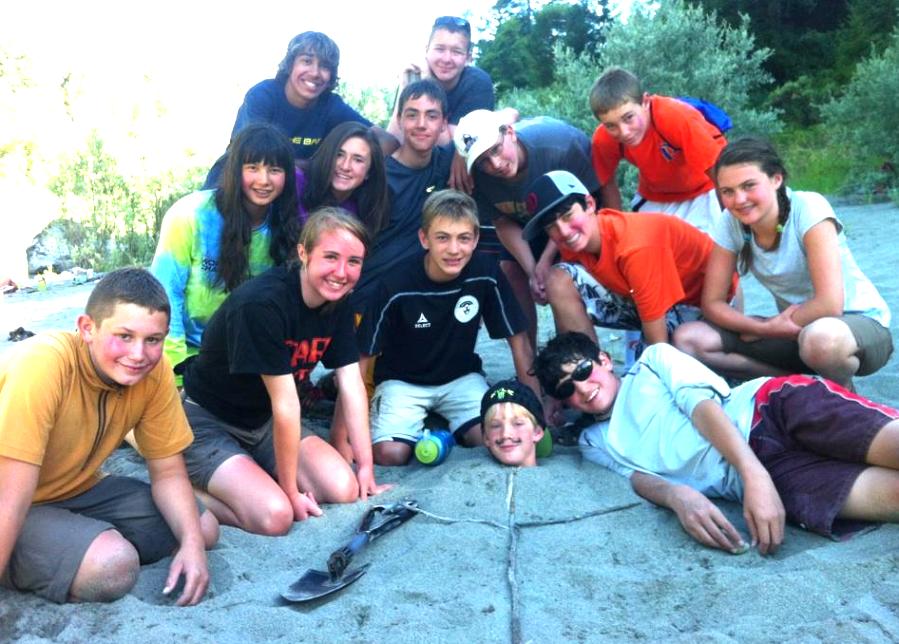
Taking a Break on the Lost Coast Beach
Without debating geographical determinism, I want to build on Kaplan’s theories. Civilization flourishes in temperate zones. His hypothesis is that where weather is more seasonal, one has to intentionally plant crops rather than harvest fruit. One has to figure out ways to stay warm in winter and find light for long winter evenings. People have to work together to survive and this focus on collaboration fosters the sharing of ideas which moves a civilization forward.
Like life in the tropics, in the book, How Children Succeed, Paul Tough argues that as parents, we have made our upper middle class children so comfortable that we are actually inhibiting their success. If civilizations need stressors to develop more fully, perhaps giving our children lives
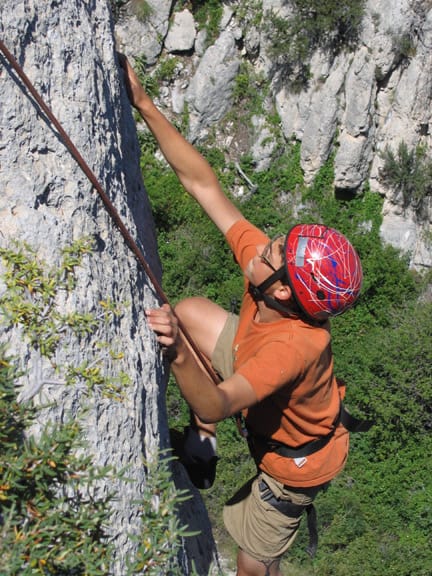
Climbing in British Columbia
filled with too much comfort is actually doing them a disservice. If we do too much for them, we may actually be crippling them, which is the last thing we intend. Resilience, picking one’s self up from failure, is one of the characteristics of successful people. If our kids don’t experience failure or even adversity, how do we raise them to become resilient and thus increase their chances of becoming successful?
Kaplan says a trained geographer can look at the natural attributes of the United States compared to the rest of the planet and instantly understand why it’s the dominant global player. The US has more and better navigable rivers and natural harbors than other countries. With small, easily traversed East Coast Mountains, two oceans and fertile plains accessed by the Mississippi River, we have won the World Geography Bee! Kaplan further asserts that because we are protected by two oceans and naturally more secure, the Unites States was automatically more receptive to the concept of democracy than say a country like Russia which was more inclined towards the protective rule of a despot because of the constant threat of invasion from the steppes.
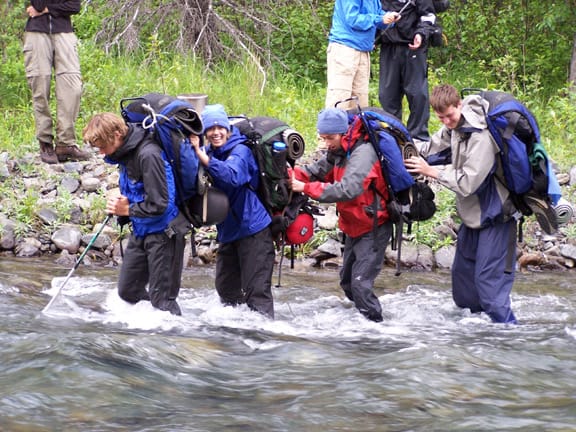
Alaska River Crossing
I would like to make the jump that like the United States, Adventure Treks is endowed with a unique advantage in the world of summer youth programming. We can take advantage of all that nature offers to create an optimal environment to help youth become more resilient and enjoy a strong community experience. Like the temperate zone, Adventure Treks is neither too comfortable nor too challenging. When one first comes to Adventure Treks, if they don’t have previous outdoor living experience, things are naturally uncomfortable. But students quickly learn ways to make outdoor living comfortable and eventually, extremely fun. Students are constantly challenged, and they learn to overcome these challenges. By working together, encouraging each other and sharing ideas, the group succeeds and great friendships are fostered. The shared challenges, the shared natural beauty and the shared adversity tends to bring people closer together in more powerful ways than if they were in a more comfortable environment (school, sports, summer camp with cabins.)
And the great thing is that though Adventure Treks students are constantly challenged and aren’t always comfortable, they are actually having the time of their lives. Learning that challenge and adversity can be your friend is another life lesson that lasts long beyond the summer.
58 days until staff training begins! We are getting excited!
Best, Dock
“It is an illusion to think that more comfort means more happiness. Happiness comes of the capacity to feel deeply, to enjoy simply, to think freely, to risk and to be needed.” – Storm Jameson
We are not among the legions that see technology as an evil to be feared. (We love our I-phones). However, we do believe we should think through the ramifications of how technological changes affect our children before we automatically embrace the next and newest gadgets. To our knowledge no one has yet written a parenting guide for the digital age. We all know the facts: A child today is five times more likely to play a video game than ride a bike. in 2010 the average 13 year old sent 3700 texts a month and spent 7.5 hours a day (53 hours / week) with some type of digital media. (Pew) By age 21, that same teenager, if a boy, will have played 10,000 hours of video games (compared with 4800 hours needed to obtain his bachelor’s degree). In 2013 the numbers are certain to be even higher!
Backpacking in Panthertown, NC
No one should deny that digital media is fun! The good news is that despite the obvious distraction of video games, most kids are still doing the same amount of homework (albeit frequently multi-tasking while studying) and still playing plenty of organized sports. It’s the time spent outdoors in nature in the company of friends that is getting displaced. Research shows that this collaborative play outside is the very activity that boosts kids’ creativity, collaboration and communication skills.
A recent post on our Facebook page by a non-Adventure Treks kid gave us cause for distress. “I don’t see the point of going outside to hike and look at mountains. I can see everything I want to see on the internet…and that’s what the internet is for!” While this is not a typical kid in 2013, do we need to worry that it could be in 2020?
At Adventure Treks, we get to watch the benefits outdoor experiences bring to digital-age teenagers every day. The cognitive and social benefits of time spent in nature are now well documented.The physical benefits are obvious; others are more subtle. Research shows that children have better brain development, and are both mentally and physically healthier if they play outside frequently. Nature experiences significantly reduce children’s stress, (and we are currently raising the most stressed out generation in history) while enhancing cognitive flexibility, problem-solving ability, self-esteem, and self-discipline. A 2012 British study on the restorative effects of nature demonstrates how time spent in nature can improve both executive function and creativity skills.
Jumping for Joy in Olympic National Park, WA
Adventure Treks is one of the very few places where teenagers will voluntarily give up their electronics and thank their parents for it! Adventure Treks is a reward, and providing a reward as an alternative to technology is always an easier parenting strategy than simply taking electronics away.
Adventure Treks unplugs us from the electronic umbilical cord. All communication is face to face and there are numerous opportunities to develop creativity and improve social competence and cohesion. At Adventure Treks, kids get to practice interpersonal interactions 16 hours a day and they get better at it. This refinement happens naturally and in a fun and exciting environment. Perhaps the best thing is that they make new friends and learn from great instructor mentors who facilitate the process.
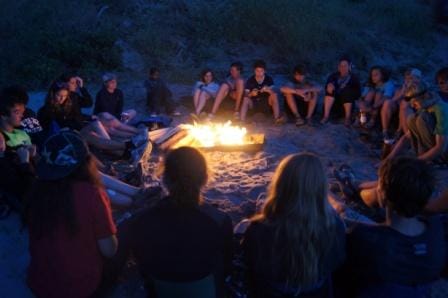
Evening Meeting on a Wilderness Beach, CA
Another benefit is a more nuanced one, when students actually unplug from electronics, they learn how that feels. Unlike their parents, many kids have never experienced life before Google, video games or a smart phone. When they experience firsthand the benefits of cultivating the interpersonal skills that their peers may be neglecting, they develop a new framework that helps them keep their technology in perspective. When electronics are returned at the end of an extended trip outdoors, they are able to observe first- hand the fundamental changes in both behavior and communication styles that comes from leaving a technology free world and reentering a world powered by the smart phone. While a return to electronics is always thrilling, teens also realize that there were also benefits to a world without technology. They now feel more empowered to make decisions about how they think technology should fit into their own lives. They now know that technology need not be all consuming. They realize they have a choice… And sometimes just giving them that power is all they need.
https://d52gwxhjtzjcm.cloudfront.net/2025/01/7.18-group-at-waterfall-300x240-sxNJVp.jpg240300AT Staffhttps://www.adventuretreks.com/wp-content/uploads/2025/02/AT-logo-white-NEW.pngAT Staff2013-02-21 17:58:232025-12-28 16:41:51Adventure Treks Can Provide Teenagers with a New Perspective on Their Technology
As the parent of four children, I witness an improvement in family dynamics whenever we are able to spend time outside together as a family. Whether it’s just playing games or better still going on a family hike or bike ride, we just seem to get along better outside. Conversations come more easily and we actually seem to listen to each other. Nobody is distracted by a digital screen, a magazine or a ringing phone. Outside, we play with each other, look out for each other, and share smiles as we witness a brilliant vista or waterfall. Somehow our kids’ complaints about “how much they hate hiking” miraculously disappear by the end of the trip.
The cognitive and social benefits of time spent in nature are now well documented. Children carry less stress; and demonstrate better brain development, better mental health and better physical health when they spend significant time outdoors and in nature. A 2012 British Study shows how even a few days spent in nature can improve both executive function and creativity skills.
Although Adventure Treks is a natural solution to the challenge of getting teenagers outdoors, three great weeks in the summer needs to be reinforced by family outdoor adventures the rest of the year. At Adventure Treks, we light a fire for a lifetime love of all things outdoors. Your job is to keep the fire stoked with regular family outdoor activities.
We get it. It’s easy to want to get your family outdoors but difficult to actually do it. Schedules are crazy. Youth sports and extra -curriculars have become all-consuming. As video games become even more “exciting,” inspiring kids to go on a family hike becomes more challenging. And then it always seems just when you have moved the heavens to get everyone commitment-free, the heavens themselves move, the rains set in and plans are postponed… until next month or next year.
Besides crazy family schedules there are also access issues, equipment issues and expertise issues. The good news is that even if you are inexperienced, if you have a child who has participated in Adventure Treks, your child should know enough basic outdoor skills, and have good enough judgment, leadership and risk management skills to be able to take an active role in planning and leading your next family excursion. Empower them and let them show off their skills!
You do want to make sure your zealous Adventure Treks kid doesn’t plan something a little too epic for all concerned! So, if you are bringing younger siblings along, I wanted to offer some strategies to make sure the younger siblings have fun, too. These are all little tricks we use at Adventure Treks and at our summer camp, Camp Pinnacle.
• First begin by understanding that in a world where kids’ frame of reference is the Harry Potter ride at Disney, a casual walk in the woods doesn’t pack the punch that a roller coaster can. Also remember that few people find walking uphill to be fun. A successful outing begins with embracing and overcoming the negatives.
• Let your child bring a friend. In fact encourage it – It will make all the difference – often the promise of a friend coming turns a potential hike from a big negative to a small positive. This can get a little sketchy when you end up with 7 kids and 1 adult, but I find my kids always behave better and are more eager to try new things with friends present.
• Limit your scope –The epic adventure you have in mind may turn kids off to the outdoors forever. Most adults have that memory of an outdoor adventure in their youth that ended in near disaster – While this makes for a good story –kids aren’t as resilient as we’re certain we used to be. If in doubt, always hike less (at least with young kids) rather than more. Just because you get out infrequently, don’t force your kids to “go big or go home!” Getting back to the car a little early is always better than hiking in the dark. Remember you are investing in the future!
• Choose a destination when possible where there is something special. Unless your child is an inspired dendrologist, few kids find rewards from just walking. The incredible view, the striking waterfall, the special swimming hole, an old shelter or a blueberry patch all serve as a reminder that effort and reward are related. If your scenery is limited have a special treat or game planned for the midpoint and find ways to embellish the neat small things you do see along the way.
• Bring goody bags – My kids don’t get a lot of candy but we loosen the rules for the woods. Giving each child a small personal snack bag from which they can eat from and trade from at will works! It’s also a great emotional intelligence test. You can predict your kids’ future success simply by seeing who finishes their goody bag before the hike begins and who saves the best treats until the end!
• Make the most of small opportunities and make use of nature’s play areas. Especially with young children, save time to play. Hold balance contests on logs, try and jump from rock to rock, cross a stream several times in different ways, and find stumps and natural ramps to jump off. Kids will often remember the time spent playing more fondly than the hiking.
• Have an arsenal of riddles, nature quizzes, word games and activities ready to make rest time along the trail fun. Games are also great filler when conversation runs thin! Never underestimate the power of a scavenger hunt and a little friendly sibling competition to add spark.
• Whip out a special treat like a fireball when the hiking gets challenging. Distractions are good. The “heat” of the fireball will help kids “forget” the steepness of the trail!
• Try to find a beautiful place along the trail, spread your kids out and give them a minute or two for reflective silence. Don’t overdo this or take it too seriously but it’s always nice to begin the habit of reflection in the outdoors. Small habits in youth pay benefits later.
I hope you can use some of these ideas to embellish your next family hike – the goal is to make time spent outdoors a family habit and keep it fun enough that they won’t argue too loudly when you want to go again!
At Adventure Treks, we want to be your partner in getting your kids outside. It’s usually easier for us to get kids excited about being outdoors than it is for you. Adventure Treks supplies the friends and “larger than life” instructor mentors who are eager to share their love for outdoor activities. Our program has been carefully designed to make outdoor activities exciting and appealing. We want kids to have fun early in the process, succeed easily and then we can build on their successes. I know this is a different approach than how we as adults did things as children. We were frequently told to “suck it up!” But times have changed and children of the digital age live in a different world than we did. If we are going to keep them outdoors and perhaps inspire the next John Muir or Rachel Carson, we have to bring young people into the outdoors gently.
The benefits of getting your kids excited about the outdoors are great. The risks of raising a child who never leaves the family basement shouldn’t be ignored. We believe that the outdoors is a wonderful tool in helping to raise great kids!
https://www.adventuretreks.com/wp-content/uploads/2025/02/AT-logo-white-NEW.png00AT Staffhttps://www.adventuretreks.com/wp-content/uploads/2025/02/AT-logo-white-NEW.pngAT Staff2013-01-21 13:24:052025-12-28 16:41:51Tips to Make Hiking Fun for Kids
I’m serving on an exploratory committee for our municipality, Flat Rock, NC that is studying the feasibility of converting an unsuccessful 55 acre golf course into a public park. If the park becomes a reality I foresee differences in opinion over what the playground “should” look like. Having already heard public comment in which well-intentioned people worry about children playing in the stream or drowning in a pond and the potential liabilities, I worry our new playground might look like the others in town—uninspiring and boring for any kid over the age of three.
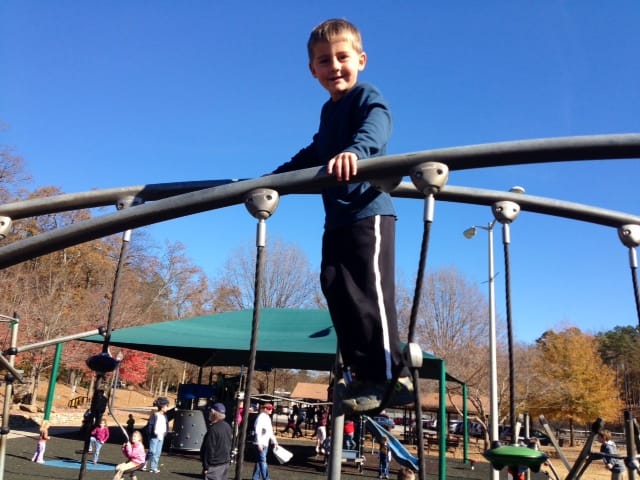
A newly designed climbing structure
Seven years ago we took our then 5, 3 and 2 year olds to New Zealand. We learned playgrounds could be different. My kids thrilled to 200 meter Flying Foxes (Zip lines), 10 meter slides, and climbing towers. The Kiwi mindset was that it was better to injure oneself at age six and thus improve judgment than make poor decisions later in life. When we returned to the States and our Consumer Product Safety Standards, my kids lost all enthusiasm for playgrounds.
As more and more kids fail the Presidential Fitness Test and childhood obesity becomes the new normal, the U.S. mindset on playgrounds is beginning to shift. Mariana Brussoni, a developmental psychologist at the University of British Columbia, suggests risky play ultimately keeps children safer by allowing them to learn how to take and manage risk. Dr. Brussoni cites a study that found those given more free-play time in their youth were more likely to participate in sports and contribute to their community as teenagers and went on to earn greater professional success than children allowed little free play. Ellen Sandseter, an associate professor at Queen Maud University in Norway says “Risky play exposes children to stimuli they may have feared, such as heights. As the child’s coping skills improve, these situations and stimuli may be mastered and no longer feared. It’s important that play environments are as safe as necessary, not as safe as possible,”
Up High and Happy!
It will be my challenge to get people in Flat Rock excited about a different type of playground. Cool new playground designs, mostly emanating from Europe, have the appeal of seeming riskier by allowing participants the real opportunity for a fall. The consequences of falling are minimized, however, through careful design which reduces the potential of a significant injury.
So what does playground design have to do with Adventure Treks?
Let’s go to the work of Paul Tough in his fabulous book, How Children Learn. “When you talk today to teachers and administrators at high-achieving high schools, their greatest concern is that their students are so overly protected from adversity, in their homes and at school, that they never develop the crucial ability to overcome real setbacks and in the process to develop strength of character. They certainly work hard; they often experience a great deal of pressure and stress; but in reality, their path through the education system is easier and smoother than it was for any previous generation. But if this new research is right, their schools, their families, and their culture may all be doing them a disservice by not giving them more opportunities to struggle. Overcoming adversity is what produces character. And character, even more than IQ, is what leads to real and lasting success.”
Similar to boring playground equipment, we are dumbing down adolescence by over protecting our kids. We may be actually hindering their growth by giving them lives of too much comfort. Our good intentions frequently lead us to rescue our kids from the consequences of their inevitable mistakes. As a parent, I know I am guilty of not giving my kids enough opportunities to learn through adversity.
Adventure Treks provides an opportunity which lets adolescents step out of their comfort zone and face some real adversity. We ratchet up the perceived risk and let teenagers face natural consequences. Days are not always easy but as the result of hard work and effort, accomplishment becomes sweeter. After an Adventure Treks summer, character, grit and resilience are strengthened. But similar to the fancy European playground equipment, the Adventure Treks experience is engineered so that the perceived risk is greater than the actual risk. And that makes an Adventure Treks summer easier on us parents.
Sources: The Wall Street Journal, “Playing it Too Safe” by Sumathi Reddy, November 19, 2012 How Children Learn: Grit, Curiosity and the Hidden Power of Character by Paul Tough, 2012
https://d52gwxhjtzjcm.cloudfront.net/2025/01/climbing-High-300x225-6u7QHh.jpg225300AT Staffhttps://www.adventuretreks.com/wp-content/uploads/2025/02/AT-logo-white-NEW.pngAT Staff2012-11-30 02:27:252025-12-28 16:41:52What do Playgrounds, Adventure Treks and Character Have in Common?
I’m going to use pumpkin carving as a metaphor for how ridiculously high the bar is being set in our global and digitized world. In my youth, my parents would present me my annual pumpkin a few days before Halloween. I would take my knife, hack out a couple triangles for eyes and a nose, try to cut a couple of teeth into the mouth, throw in the candle, and there it was – my best effort! It was all my own work and done in half an hour, or perhaps an hour if I stretched out my carving glory. I had made my contribution to the neighborhood and all the neighborhood pumpkins were equally mediocre. That being said, they all seemed plenty good to us as we roamed the neighborhood in search of tricks and treats. Sound familiar?
Fast forward to 2012: The pumpkins of my youth would be ridiculed—I haven’t seen a triangle nose in years! Much of America is now too busy to even carve their own pumpkins and opt for the hand carved foam pumpkins available on EBay instead. Other parents fear that with thousands of stencils to download, their ten year old doesn’t stand a chance of carving a pumpkin that will meet the new normal. So they end up carving the pumpkin themselves. I hate to admit it, but I was just about to fall into that category. My five year old was obsessed with creating a dragon pumpkin. After dozens of Google searches and pages of complicated dragon pumpkin stencils (some of which cost $6.99 to download – Not going to happen!), I had to admit to Charlie – that while I was surely good at something – I was hardly the Picasso of pumpkin carving and we would have to go for something much less ambitious. Tears were shed!
Although we knew our best effort would pale in comparison to all that we had seen on the internet, we decided the only alternative was to create our own pumpkin. It was neither the fanciest, the scariest or the most unique, but it was our pumpkin. No stencils, no dragons, and yet it was certainly scary and worthy enough to adorn our front stoop. And Charlie even got to use a knife. We did it together and we had fun. The process was much more rewarding than the result. The neighbors may grimace at our low rent pumpkin, but we had fun because we lowered the bar and enjoyed the experience!
The bottom line is that the high bar for everything is stressing out our kids… and us parents. Our kids wonder if they are going to measure up. And they feel our stress as we wonder too. Sure the stakes in the global economy are so much higher than they used to be, but there are costs to raising our kids to be “exceptional” that aren’t always taken into account. As parents, we have certain images of success in our minds for our kids—sports championships, music recitals, high grades, attending an Ivy League school—and with our high expectations, some kids are becoming more afraid of failure than ever before. High expectations are a good thing. We want our kids to do well. Having unrealistic expectations isn’t healthy, nor is raising kids who feel that they aren’t allowed to fail.
And isn’t it possible that we may be setting the wrong goals for our kids? What if we reframed it?
What if we focused less on specific goals and more on one simple question: How as parents do we help our children shine? Put differently, we should worry less about creating goals for our children and more about finding environments where they will experience successes and acceptance.
“A great environment” has three important components. First, it should be a good match to a child’s talents and interests—a place that they show skill and feel a desire to improve their skills.
Second, the “great environment” should provide challenges and opportunities to grow by overcoming these challenges: “confidence comes from competence”. And resilience comes because of hard work and even more through picking oneself up after failure. That “great environment” is a place where the culture says it’s OK to fail, and provides plenty of support when you do.
The final component of a “great environment” is community and acceptance. This component is often neglected when parents consider activities for their children. But as I look at my daughters’ soccer team at the end of the season, far more important than the skills they gained and the games won or lost, was the incredible rapport the girls developed and the friendships that extend beyond the field. To me soccer is merely the vehicle for healthy friendships, healthy bodies and a respect for all that comes as a result of hard work. Some of their coaches see it differently, but we are used to that!
Which brings me to Adventure Treks. Ultimately our goal is to create that “great environment” for your child. We typically hear from parents that their son or daughter had a great time at Adventure Treks, made great friends and loved their instructors. They say it was one of the healthiest and happiest times of their lives. They say that their kids loved being in a place that didn’t judge them and loved them for who they were, not who they were “supposed to be.” Then we hear: “We can’t do A.T. next summer because of summer select lacrosse, or a community service requirement, or the chance to get some college credits or learn a new language… and these opportunities for enrichment just can’t be missed!”
And we respond: While the benefits of a summer outdoors cannot be quantified, isn’t the opportunity to celebrate more simple things like friends, the wonders of nature and the chance to live in a supportive community ultimately going to yield more long term success and happiness? Isn’t developing resilience, character and communication skills important too? Is fulfilling a checklist of accomplishments that are often pursued—not for love of the activity, but to measure up to someone’s perceived expectations worth missing out on the magic of A.T.?
Sometimes the simplest pumpkin is the most satisfying. Charlie and I are both glad we chose not to carve that dragon. It was just too much for us and by carving our own “design,” we were ultimately happier.
Thanks to photographic evidence pulled from instructor cameras, we have confirmed a few different things about The Adventure Treks 2012 summer: there was lots of singing, we played hard on everything from mountain bikes to whitewater rafts, danced more than we sang, made lots of new friends, and had a lot of fun.
Hope you enjoy these memories as much as we have and don’t forget to sign up for next summer! The best early booking discounts expire On Oct 15, 2012. Summer 2013 – our 20th summer is going to be one to remember!
We may request cookies to be set on your device. We use cookies to let us know when you visit our websites, how you interact with us, to enrich your user experience, and to customize your relationship with our website.
Click on the different category headings to find out more. You can also change some of your preferences. Note that blocking some types of cookies may impact your experience on our websites and the services we are able to offer.
Essential Website Cookies
These cookies are strictly necessary to provide you with services available through our website and to use some of its features.
Because these cookies are strictly necessary to deliver the website, refusing them will have impact how our site functions. You always can block or delete cookies by changing your browser settings and force blocking all cookies on this website. But this will always prompt you to accept/refuse cookies when revisiting our site.
We fully respect if you want to refuse cookies but to avoid asking you again and again kindly allow us to store a cookie for that. You are free to opt out any time or opt in for other cookies to get a better experience. If you refuse cookies we will remove all set cookies in our domain.
We provide you with a list of stored cookies on your computer in our domain so you can check what we stored. Due to security reasons we are not able to show or modify cookies from other domains. You can check these in your browser security settings.
Other external services
We also use different external services like Google Webfonts, Google Maps, and external Video providers. Since these providers may collect personal data like your IP address we allow you to block them here. Please be aware that this might heavily reduce the functionality and appearance of our site. Changes will take effect once you reload the page.
Google Webfont Settings:
Google Map Settings:
Google reCaptcha Settings:
Vimeo and Youtube video embeds:
Privacy Policy
You can read about our cookies and privacy settings in detail on our Privacy Policy Page.